

By Dr. Ahn Sung-jae the Chief Plastic Surgeon, DL Plastic Surgery, Seoul
For international patients considering rhinoplasty in Korea, planning the surgery itself is only one part of the process.
Two of the most common questions I hear from patients traveling from overseas are:
“How long should I stay in Korea after rhinoplasty?”
and
“When is it safe for me to fly home?”
These questions should ideally be discussed before booking a return flight.
Rhinoplasty recovery continues for months, but this does not mean an international patient needs to remain in Korea until the nose has completely healed. The more practical goal is to remain long enough to pass through the initial postoperative period, attend the necessary follow-up appointments, and allow the surgeon to assess early healing before departure.
For many patients, this means planning their stay around the first postoperative follow-up and splint removal, rather than simply choosing the earliest possible flight home.
How Long Should International Patients Stay in Korea?
There is no single number of days that is appropriate for every rhinoplasty patient.
The recommended length of stay can depend on:
- The type and complexity of rhinoplasty
- Whether the procedure is primary or revision rhinoplasty
- Whether cartilage grafting was performed
- The patient’s general health and healing response
- The amount of swelling or bruising
- When the splint, sutures or other postoperative materials need to be removed
- Whether any early postoperative concerns require additional observation
A nasal splint commonly remains in place for approximately one week, although the exact timing varies according to the procedure and the surgeon’s protocol. NHS guidance, for example, describes splint removal at approximately 7–10 days after rhinoplasty, while Mayo Clinic notes that an external splint is usually kept in place for about one week.
For an international patient, this first follow-up period can therefore be an important part of travel planning.
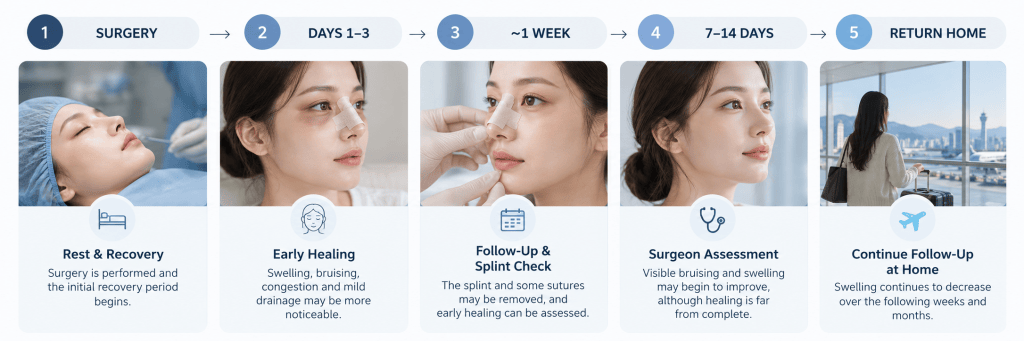
A General Planning Timeline
| Stage | What may happen | Travel consideration |
| Surgery day | Rhinoplasty is performed and the initial recovery period begins. | Rest and follow your surgical team’s postoperative instructions. |
| Days 1–3 | Swelling, congestion, bruising and mild drainage may be more noticeable. | Stay close to your clinic and avoid unnecessary travel or strenuous activity. |
| Around 1 week | Depending on the procedure, the splint and some sutures may be removed and early healing can be assessed. | This is an important follow-up point for many international patients. |
| 7–14 days | Visible bruising and swelling may begin to become more manageable, although healing is far from complete. | Depending on your operation and your surgeon’s assessment, travel may become possible. |
| After returning home | Swelling continues to decrease over the following weeks and months. | Follow-up should continue according to the plan arranged with your surgical team. |
This timeline is a general guide, not an individual medical recommendation. Your surgeon may recommend a shorter or longer stay depending on the procedure and your recovery.
Mayo Clinic notes that swelling and bruising can remain visible for two to three weeks, while the nasal swelling itself can take considerably longer to resolve. Cleveland Clinic likewise notes that rhinoplasty healing varies between patients and that swelling may continue for months.
When Can You Fly After Rhinoplasty?
There is no universal flight date that applies to every patient.
The American Society of Plastic Surgeons advises waiting approximately 7–10 days after cosmetic facial procedures, including rhinoplasty, before flying. Cambridge University Hospitals’ postoperative guidance for septorhinoplasty advises avoiding air travel for two weeks.
The difference illustrates an important point:
Your flight should be planned around your individual recovery and your surgeon’s assessment—not simply around the minimum number of days you can stay in Korea.
The extent of surgery matters. A relatively limited primary rhinoplasty and a complex revision involving extensive structural reconstruction are not necessarily expected to follow the same recovery course.
Before leaving Korea, your surgeon may want to evaluate the condition of the surgical site, swelling, breathing and overall early healing.
Why Can Flying Soon After Surgery Be a Concern?
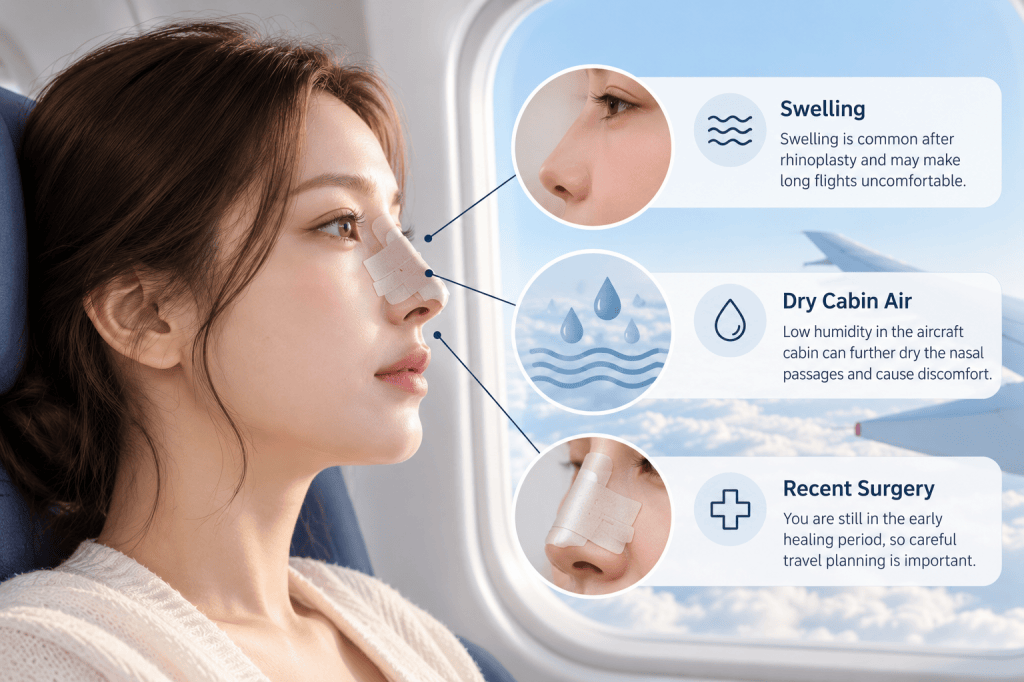
Air travel shortly after surgery introduces several considerations.
Swelling and discomfort
Swelling is expected during the early postoperative period. Sitting for a long flight while you are still in the initial phase of recovery may make the journey uncomfortable.
ASPS also notes that travel combined with recent surgery can add to postoperative concerns, including swelling and the general risks associated with prolonged travel after an operation.
Dry cabin air
Aircraft cabins have low humidity.
After nasal surgery, the inside of the nose may already feel dry, congested or sensitive. NHS postoperative guidance notes that cabin air can further dry the nose and potentially contribute to bleeding.
Access to your surgeon
Another practical concern is not the flight itself but what happens if a problem develops after you leave Korea.
During the early postoperative period, being close to the surgical team makes it easier to evaluate unexpected bleeding, significant pain, abnormal discharge or another concerning change.
Once you return overseas, an in-person examination by the original surgeon may no longer be immediately available.
For this reason, postoperative care should be planned before departure rather than after a problem occurs.
Should You Fly Home With Your Nasal Splint Still On?

This should be discussed directly with your surgeon.
In many rhinoplasty protocols, an external splint remains on the nose for approximately one week.
For international patients, arranging the return flight after the planned splint-removal appointment can have practical advantages.
It allows the surgical team to examine the nose, assess early healing and provide updated instructions before the patient leaves Korea.
However, splint removal itself does not mean that the nose has completely healed or that every patient is automatically ready to fly.
The decision still depends on the individual recovery.
What Should You Do Before Your Flight Home?
Before leaving Korea, make sure you understand your postoperative plan.
It can be useful to confirm:
- Whether your surgeon considers you ready for air travel
- When your next follow-up should take place
- How to clean or care for the nose after returning home
- Which medications should be continued
- Which activities should still be avoided
- How to contact the clinic from overseas
- Which symptoms require medical attention
- Where to seek local medical care if an urgent problem develops
Do not start decongestants, nasal sprays or other medications specifically for the flight unless they have been approved by your treating medical team.
This is particularly important after rhinoplasty because general advice intended for ordinary airline passengers may not be appropriate for a recently operated nose.
What About Luggage?
This is easy to overlook when planning medical travel.
After rhinoplasty, patients are generally advised to avoid strenuous activity during early recovery. Mayo Clinic specifically recommends avoiding intense physical activity after surgery, while Cleveland Clinic advises avoiding heavy lifting during the early recovery period.
For an international patient, this has a very practical implication:
Do not assume you will be able to handle a heavy suitcase normally immediately after surgery.
Consider traveling with lighter luggage or arranging assistance with heavy bags at the airport.
Also be particularly careful when removing items from overhead compartments. An accidental impact to the nose during early healing should be avoided.
Is It Better to Stay in Korea Longer?
Staying longer does not necessarily make the final rhinoplasty result better.
The purpose of remaining in Korea after surgery is primarily to allow appropriate early postoperative care and follow-up—not to wait for all swelling to disappear.
Initial swelling generally improves over the first several weeks, but subtle swelling can remain for many months and the nasal contour may continue refining for up to a year.
International patients therefore do not normally need to remain in Seoul until the final result is visible.
What matters is having an appropriate plan for the transition from in-person postoperative care in Korea to continued recovery at home.
What Happens After You Return Home?
Rhinoplasty recovery does not end when you board your flight.
Your nose will continue changing for weeks and months after you leave Korea.
Before departure, international patients should know how follow-up will be managed. Depending on the clinic and individual circumstances, this may involve scheduled photographs, remote communication and local medical assessment when necessary.
Photographs can help document healing, but they cannot replace an in-person medical examination when a complication is suspected.
Seek medical assessment if you develop symptoms such as significant or increasing pain, fever, abnormal discharge, substantial breathing difficulty or uncontrolled bleeding.
Frequently Asked Questions
Can I fly home one week after rhinoplasty?
Some guidance places air travel after facial cosmetic surgery, including rhinoplasty, in approximately the 7–10 day range, while other postoperative guidance recommends waiting two weeks.
Whether one week is appropriate for you depends on the procedure performed and how you are healing.
Your surgeon should make the final recommendation before you fly.
Should I book my return flight before surgery?
International patients naturally need to arrange travel in advance.
However, when possible, avoid making a very tight itinerary that leaves no flexibility if your surgeon recommends an additional follow-up or a later departure.
Your planned departure date should be discussed during the preoperative consultation.
Do I need to stay in Korea until all swelling disappears?
No.
Swelling can continue for months, and subtle changes may occur for up to a year. Remaining in Korea throughout this process is generally unnecessary.
The important consideration is completing the appropriate early follow-up and having a clear plan for continued care after returning home.
Can I travel around Korea immediately after surgery?
The first postoperative days should be considered a recovery period, not a sightseeing vacation.
ASPS specifically cautions that vacation activities after cosmetic surgery can interfere with recovery and recommends avoiding activities such as extensive tours, exercise, swimming and alcohol during postoperative healing.
Plan sightseeing before surgery, or discuss with your surgeon when light activities can safely resume.
A Surgeon’s Perspective
For international patients, rhinoplasty requires two plans: a surgical plan and a travel plan.
The operation may take only a few hours, but postoperative care continues long after the procedure itself.
When a patient travels to Seoul for rhinoplasty, I recommend discussing the return journey before surgery. We need to consider not only when the patient would like to leave Korea, but also when postoperative examinations are required, how the patient is healing and how follow-up will continue after returning home.
At DL Plastic Surgery in Seoul, planning for international patients should therefore include the period before surgery, the initial recovery in Korea and the transition to postoperative care after departure.
If you are traveling to Korea for rhinoplasty, ask your surgeon how long you should stay, when you can fly and how follow-up will continue once you return home.
A well-planned recovery is just as important as a well-planned trip.
Medical References
American Society of Plastic Surgeons (ASPS), Briefing Paper: Cosmetic Surgery Tourism American Society of Plastic Surgeons
American Society of Plastic Surgeons (ASPS), Rhinoplasty Recovery American Society of Plastic Surgeons
Mayo Clinic, Rhinoplasty Mayo Clinic
Cleveland Clinic, Rhinoplasty: Surgery, Recovery, Before & After Cleveland Clinic
Cambridge University Hospitals NHS Foundation Trust, Information After Septorhinoplasty Cambridge University Hospitals
Medical Disclaimer: This article provides general educational information and does not establish an individual timeline for air travel after surgery. Recovery varies according to the patient and the procedure performed. Follow the instructions of your treating surgeon and obtain medical clearance before traveling after rhinoplasty.

