Solid Rib for Structural Support, Molded Rib for the Nasal Bridge
Revision rhinoplasty requires a different approach from primary rhinoplasty. Previous surgery can weaken the nasal framework, use up the available septal cartilage, and leave scar tissue, contracture, or a problematic implant behind. In patients who have undergone multiple procedures, septal or ear cartilage is often no longer enough.
In these situations, autologous rib (costal) cartilage becomes the main source of graft material. A single harvest can supply cartilage for two very different jobs: solid carved grafts that rebuild the structural framework of the nose, and a molded rib graft that replaces a dorsal implant on the nasal bridge (dorsum).
KEY IDEA
Rib cartilage is not one technique. Solid rib rebuilds the framework (tip, septum, columella, alar support), while molded rib reconstructs the dorsum. The plan starts with which structures need to be preserved, reinforced, repositioned, or reconstructed, and then assigns the right form of cartilage to each role.
Why Rib Cartilage in Revision Rhinoplasty?
After several operations, the septum may already have been harvested or may be too weak to support the nose, and ear cartilage is soft and limited in amount. Rib cartilage offers a much larger volume of strong cartilage, which matters when both the framework and the bridge need to be rebuilt at the same time.
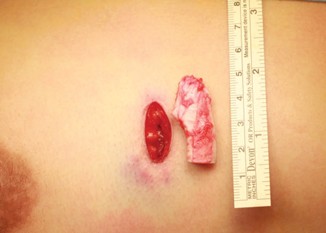
Role 1: Solid Rib Cartilage for Structural Support
When the nasal tip has lost support, or the nose has become short or upturned, raising the bridge alone is not enough. Carved solid rib cartilage provides the strength needed to rebuild the framework, for example as a:
- septal extension graft to support and reposition the tip
- columellar strut and lengthening graft
- alar rim or batten graft for alar support
- spreader graft to reinforce the middle vault
The main consideration with solid rib cartilage is warping, a gradual change in shape after surgery. Careful selection of the cartilage, balanced carving, and secure fixation help reduce this risk.
Role 2: Molded Rib Cartilage for the Nasal Bridge
A molded rib graft is made by dicing harvested rib cartilage into very small pieces and binding them together with fibrin glue, a biologic tissue sealant. The mixture is shaped, using a mold or by hand, into a single graft with a planned length, width, height, and tapered edges, much like a carved silicone implant.
Its main advantage is customizability. Because the graft is built from small pieces rather than carved from a single block, it can be shaped to control not only the height and width of the bridge but also its overall curvature and the transition from the bridge to the tip, creating a smooth, tailored dorsal contour.
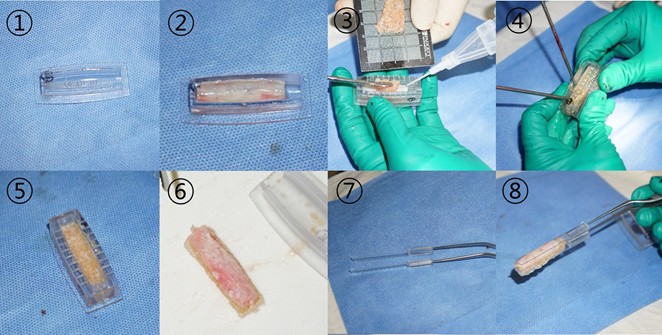
Once the glue sets, the graft holds its shape and is inserted into the dorsal pocket in the same way a silicone implant is placed on the nasal bridge. Over time, the fibrin glue is absorbed and the cartilage pieces become incorporated into the surrounding tissue.
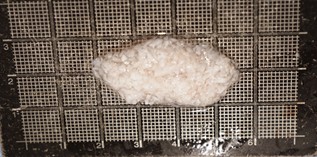
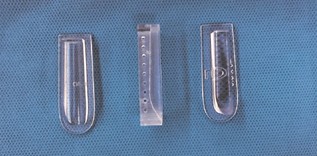
Figure 3. Close-up of the materials. Left: rib cartilage finely diced (grid shown for scale). Right: transparent molds used to shape the graft to the planned dorsal dimensions.
MOLDED RIB AS A DORSAL GRAFT
Molded rib takes over the job that a silicone implant does on the bridge. Tip support, nasal length, and columellar position are still handled by solid structural grafts. In complex revisions, the two are often used together from the same rib harvest.
Solid Rib vs. Molded Rib vs. Silicone
The table below compares each option by the role it plays. Solid rib and molded rib are complementary; the meaningful comparison for the nasal bridge is between molded rib and a silicone implant.
| Solid rib graft | Molded rib graft | Silicone implant | |
| Main role | Structural support | Dorsal augmentation and contour | Dorsal augmentation |
| Where it is used | Tip, septum, columella, alar rims | Nasal bridge | Nasal bridge |
| Material | Carved autologous cartilage | Diced autologous cartilage bound with fibrin glue | Synthetic implant |
| Structural support | Strong | None (contour only) | None (contour only) |
| Warping | Possible; reduced by carving and fixation | Minimal (no single block) | Not applicable |
| Infection | Autologous tissue | Autologous tissue; no permanent foreign body | Foreign body; infection usually requires removal |
| Capsular contracture | None | None | Capsule forms; contracture can shorten and lift the nose |
| Long-term volume | Generally stable | Partial resorption possible | Stable |
| Donor site | Chest incision | Chest incision (same harvest) | None |
When Molded Rib Is Especially Useful
After a Silicone Implant Infection
When a silicone implant becomes infected, the implant usually has to be removed, because bacteria can persist on the implant surface. The pocket left behind is scarred, and placing another implant into a previously infected field carries a risk of recurrent infection.
Molded rib allows the bridge to be rebuilt with an implant-like shape while leaving no permanent foreign body in the nose. Autologous cartilage generally tolerates a previously infected, scarred field better than a synthetic implant. Reconstruction is usually planned after the infection has resolved and the tissues have recovered, and the timing is decided case by case.
Contracted Nose
A contracted nose develops when the capsule around an implant, often after infection or repeated surgery, thickens and shrinks. The skin and soft tissue tighten, pulling the tip upward and making the nose look shorter, with more of the nostrils showing.
Correction typically involves removing the implant and capsule, releasing the scarred soft tissue, and lengthening the nose with solid rib grafts such as a septal extension graft. The dorsum is then reconstructed with molded rib instead of a new implant, which avoids forming a new capsule that could contract again. Because it is shaped to fit, molded rib can also be tailored to a tight, scarred skin envelope. This is a typical case where both forms of rib cartilage work together.
Other Situations
- A visible or shifted implant under thin or damaged skin
- Dorsal irregularity or asymmetry after previous surgery
- Insufficient septal cartilage after multiple procedures
- A patient who prefers a fully autologous reconstruction
Limitations to Discuss Before Surgery
- A chest incision and temporary donor-site discomfort
- Partial resorption of the molded graft over time, which can reduce dorsal height
- A softer dorsal line than a sharply carved implant, depending on skin thickness
- Longer operating time and a longer period of swelling than a simple implant revision
- Not every implant problem requires rib cartilage; skin condition, scar tissue, and the amount of augmentation needed all affect the choice
Revision Rhinoplasty Is About Structural Reconstruction
The choice of material should come after evaluating the nasal structure: the existing implant, remaining septal cartilage, tip support, scar tissue, skin thickness, nasal length, columellar position, and nostril exposure.
The goal is not simply to make the nose higher. The goal is to rebuild a stable framework and create a balanced contour appropriate for the patient’s anatomy and previous surgical history.
Frequently Asked Questions
Can rib cartilage be used after multiple rhinoplasty procedures?
Yes. Rib cartilage is often considered when septal or ear cartilage is no longer sufficient after previous surgery.
What is the main advantage of a molded rib graft?
Customizability. It can be shaped to control dorsal height, width, curvature, and the bridge-to-tip transition more precisely, while avoiding the warping concern of a single solid block.
Is a molded rib graft the same as a silicone implant?
No. It is shaped and placed on the bridge like an implant, but it is made from the patient’s own diced rib cartilage held together with fibrin glue, which is gradually absorbed.
Does a molded rib graft support the nasal tip?
No. Molded rib is used for the dorsum. Tip support and nasal lengthening require solid structural grafts, which can be made from the same rib harvest.
Can rib cartilage warp?
Solid carved rib cartilage can warp, which is why carving and fixation matter. Molded rib is made of small pieces rather than a single block, so warping is not a meaningful concern; the main consideration is partial resorption.
Can molded rib be used after an implant infection?
In many cases, yes. Once the infection has been treated and the tissues have recovered, molded rib can rebuild the bridge without placing another foreign body.
Can the reconstruction be completely implant-free?
Yes, when the dorsum is rebuilt with molded rib and the tip with solid rib grafts. Whether this is the best plan depends on each patient’s anatomy and goals
Conclusion
Previous surgery can alter cartilage, scar tissue, skin, nasal support, and implant position. Autologous rib cartilage addresses this in two ways: solid rib grafts rebuild the framework, and molded rib, shaped with fibrin glue like an implant, reconstructs the nasal bridge.
Molded rib is particularly valuable after implant infection and in contracted noses, where placing another silicone implant carries a higher risk. The most important factor is not the material itself, but whether the nasal framework can be rebuilt in a stable way while creating a natural shape that suits the patient’s anatomy.
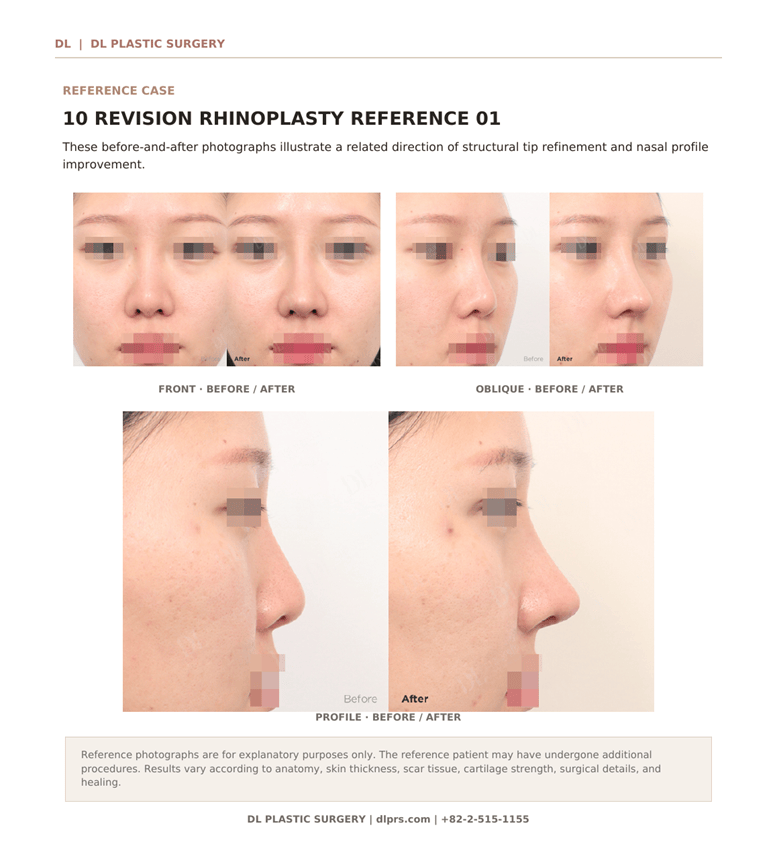
DL Revision Rhinoplasty Reference Case
The following DL before-and-after case is included to illustrate a related direction of structural tip refinement and nasal profile improvement. The reference library does not independently confirm that this patient underwent the specific molded autologous rib cartilage technique discussed in this article, so the photographs are presented as a revision-rhinoplasty reference only.