
Recovery timelines, Pitanguy ligament repair, and personalized postoperative care
DL Plastic Surgery Medical Team | Seoul, South Korea
How long does swelling last after rhinoplasty? Most visible swelling improves over the first few weeks, while subtle changes, especially around the tip, can continue for a year or longer. Surgical technique, individual anatomy, and postoperative care all influence recovery. Persistent fullness deserves assessment rather than assumptions about swelling alone. [1–4]
A rounded tip or wider-looking bridge after splint removal can be unsettling. This guide explains the usual recovery stages, the role of precise tissue handling and Pitanguy ligament repair, and what to ask about hyperbaric oxygen therapy as part of an individualized care plan.
Rhinoplasty swelling timeline
These are broad patterns, not a guaranteed schedule. Splint removal, returning to work, and seeing the final contour are different milestones. [1,2]
| Stage | Typical changes | What this means |
| First 1 to 2 weeks | Swelling, bruising, and congestion may be present. Splints are removed as directed. | The early appearance is not the final result. |
| Following weeks | Visible swelling and bruising generally become less noticeable. | Feeling ready for social activities does not mean healing is complete. |
| Following months | Residual swelling settles and contours become clearer. | Continue the follow-up plan even after returning to daily activities. |
| Around 1 year or longer | Fine changes may continue, particularly around the tip. | Your surgeon assesses when tissues have sufficiently settled. |
Why the nasal tip can remain swollen
The tip may take longer to refine than the bridge. Skin and soft-tissue characteristics, the extent of surgery, and previous operations can influence the course of healing. Early photographs cannot reliably predict the final contour. [1,3,4]
Pitanguy ligament repair and supratip fullness
Recovery planning begins during surgery. Precise dissection and careful suturing are important parts of tissue management. One structure that may be addressed in open rhinoplasty is the Pitanguy ligament, a soft-tissue attachment associated with the nasal tip and supratip region. [5]
What is supratip fullness
The supratip is the area immediately above the nasal tip. Fullness here can obscure the subtle transition from the bridge to the tip, called the supratip break. An early swollen appearance and a persistent contour problem are not the same; the cause should be assessed during follow-up.
How Pitanguy ligament reconstruction may help
When appropriate to the surgical plan, repair or reconstruction of this attachment may help control soft-tissue positioning and support a more defined supratip contour. It is a technique to discuss with your surgeon, rather than a procedure every patient necessarily needs.
A 2025 retrospective study by Şirinoğlu and colleagues compared 120 open-rhinoplasty patients across three groups: preservation, excision, and repair of the Pitanguy ligament. The repair group had a deeper supratip break at 12 months. These findings support a potential role in reducing persistent supratip fullness or pollybeak deformity. [5]
The study assessed contour at 3 and 12 months; it did not directly establish that early postoperative swelling resolves faster. A more defined contour should therefore not be presented as proof of accelerated swelling reduction.
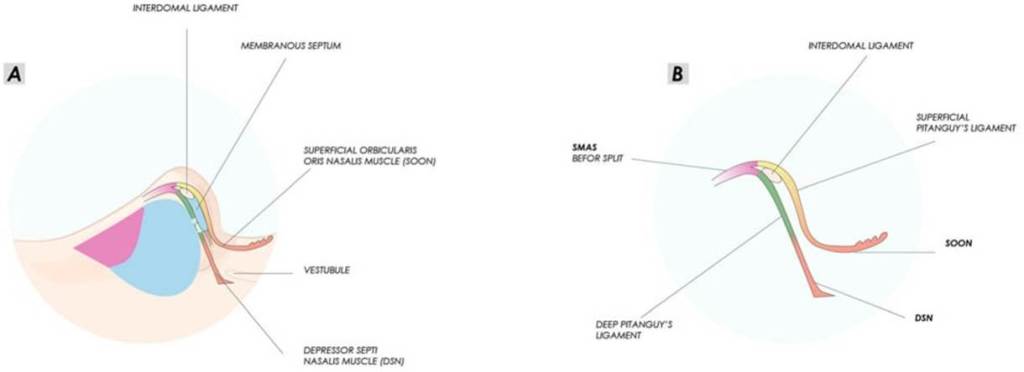
Pitanguy ligament anatomy in relation to the nasal tip and surrounding soft tissues. Anatomical illustration; not a before-and-after result.
What to ask during consultation
Ask whether ligament preservation or repair is relevant to your anatomy, how supratip fullness will be monitored, and how your surgeon distinguishes residual swelling from scar tissue or a structural contour concern.
Personalized care and hyperbaric oxygen therapy
Aftercare should match the procedure and the patient’s healing needs. Hyperbaric oxygen therapy, or HBOT, involves breathing oxygen in a pressurized chamber. A clinician may consider it as an adjunct in selected circumstances; it is not a substitute for examination or routine follow-up. [6,7]
How HBOT affects oxygen delivery and healing
Increased oxygen availability. HBOT raises the amount of oxygen dissolved in plasma and can increase tissue oxygen levels. This is more precise than saying it simply increases blood flow: tissue oxygen can rise even when blood vessels temporarily constrict. [7,8]
Microcirculation and edema. Changes in small-vessel function and fluid movement may help limit edema in certain clinical settings while maintaining oxygen delivery. These mechanisms do not establish that HBOT consistently clears ordinary rhinoplasty swelling or bruising faster. [7,8]
Inflammatory and immune responses. HBOT can influence inflammatory signaling and oxygen-dependent immune functions involved in wound healing. The clinical benefit depends on the condition being treated; increasing all white-cell activity is not the same as reducing inflammation. [7]
Does HBOT shorten rhinoplasty recovery
Reliable evidence for routine swelling reduction after uncomplicated rhinoplasty remains limited. A 2025 systematic review of facial plastic and reconstructive surgery included only three observational studies and found insufficient evidence to establish effectiveness in these settings. Physiological rationale should be distinguished from a proven recovery benefit. [6]
If HBOT is proposed, ask what specific problem it is intended to treat, what benefit is expected in your case, and how progress will be measured. Treatment requires medical screening and supervision; potential adverse effects include ear pressure injury, temporary visual changes, and oxygen toxicity. [9]
Daily care during rhinoplasty recovery
Follow your own surgical team’s instructions. Common precautions include keeping the head elevated initially, avoiding nose blowing as directed, and protecting the nose from pressure, including glasses. Do not apply ice or cold packs directly to the nose. Ask before resuming exercise or adding treatments. [4]
When to seek medical attention
Contact your surgical team promptly for severe pain, fever, yellow discharge, breathing difficulty, or uncontrolled bleeding. Severe breathing difficulty or heavy bleeding that does not stop needs urgent medical care. Do not treat these symptoms as ordinary swelling or wait for an adjunctive therapy to resolve them. [3]
Frequently asked questions about rhinoplasty swelling
Can uneven swelling make my nose look crooked
Yes, swelling can be uneven during early recovery. However, persistent or worsening asymmetry should be examined rather than diagnosed from a photograph alone. [3]
Is the result final when the splint comes off
No. Splint removal is an early recovery milestone. The nasal contour can continue changing for months afterward. [1,2]
Why does my nose look more swollen in the morning
Swelling can fluctuate and may be more noticeable in the morning during the first year. Discuss changes that are worsening or concerning with your surgeon. [1]
Does remaining swelling mean I need revision surgery
No. Swelling alone does not establish a need for revision rhinoplasty. Elective additional surgery is generally considered after sufficient healing, often at least a year; suspected complications need earlier assessment. [4]
Can Pitanguy ligament repair prevent all supratip fullness
No technique guarantees that fullness will not occur. The published study supports an association with improved supratip contour, but individual anatomy, tissue response, and the overall surgical plan still matter. [5]
Should every rhinoplasty patient receive HBOT
No. It should be considered only after an individual assessment and a discussion of the treatment goal, evidence, risks, and alternatives. It is not established as necessary routine aftercare for all rhinoplasty patients. [6,9]
Planning rhinoplasty recovery in Seoul
When discussing rhinoplasty with DL Plastic Surgery in Seoul, ask how surgical tissue management and postoperative care will be tailored to your case. Clarify whether Pitanguy ligament repair or HBOT is relevant, rather than assuming either is required.
For a useful follow-up, note when a change began, whether it is improving, and whether it affects appearance, breathing, or comfort. Bring photographs taken at comparable angles and lighting, along with questions about activity restrictions and the next review.
If you will return overseas, arrange follow-up and an emergency contact before departure. Ask where to seek local care if a concern develops after returning home. Recovery planning should address both appearance and function.
This article provides general education, not an individual diagnosis. Recovery and results vary. Follow your treating surgeon’s instructions.

