
“What kind of nose is considered beautiful?” This is one of the most common questions patients ask during a rhinoplasty consultation.
There is no single universal answer. Textbooks provide standard measurements, researchers identify average nasal proportions, and preference studies show which features people tend to find attractive. Yet those standards do not always agree with one another.
More importantly, a nose that looks balanced on one face may look too high, too long, or too projected on another. This is especially relevant in Asian rhinoplasty, where the forehead, midface, lips, chin, skin thickness, and cartilage strength can influence how every change to the nose is perceived.
The most natural rhinoplasty result is not created by copying one ideal nose. It comes from finding the proportions that look most balanced within the individual patient’s face.
In Brief
- There is no single ideal measurement that applies to every face.
- Korean and Western measurements differ most clearly at the bridge and radix, not necessarily at tip projection.
- The apparent position of the tip is influenced by the columellar base, upper lip, and chin as well as the tip itself.
- Natural-looking results depend on surface lines, highlights, and shadows—not only angles and ratios.
What Makes a Nose Look Natural?
A natural-looking nose is generally evaluated through three connected elements:
- Angles: how the nose transitions into the forehead and upper lip
- Proportions: the relationship among nasal length, bridge height, radix height, and tip projection
- Surface aesthetics: the lines, highlights, shadows, and contours created by the underlying bone and cartilage
These elements must be assessed from the front, profile, and base views. A profile photograph cannot accurately show nostril width, while a frontal photograph alone cannot explain tip rotation or the transition from the forehead to the bridge.
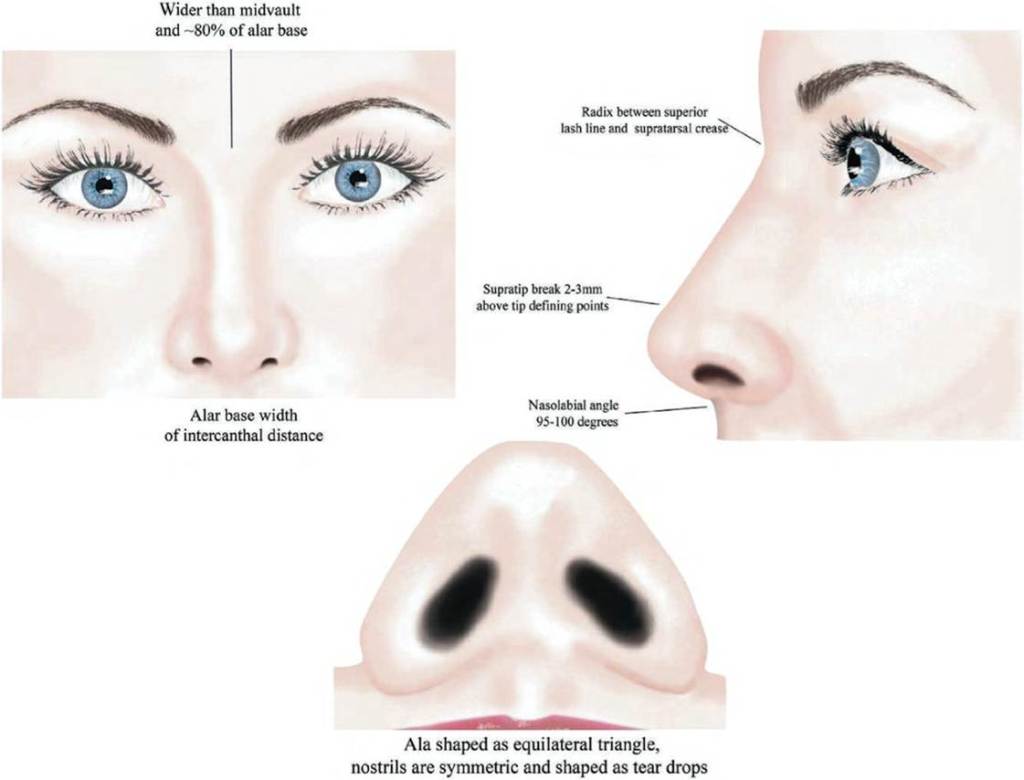
Figure 1. Traditional reference points assessed from the frontal, profile, and basal views. The alar width is compared with the intercanthal distance; the basal outline approaches an equilateral triangle; and the nostrils are described as teardrop-shaped. Source: Brito 2020, Fig. 4.
The Classic Ideal Nose Ratio
One of the most frequently cited traditional nasal ratios is 2 : 1 : 1 : 0.75.
| Reference | Nasal length | Tip projection | Dorsal height | Radix height |
| Western reference | 2 | 1.00 | 1.00 | 0.75 |
| Korean measurement | 2 | 0.97 | 0.61 | 0.28 |
The ratios are reference measurements, not mandatory surgical targets.
In the classic Western model, nasal length is represented as 2, while tip projection and dorsal height are each 1 and radix height is 0.75. The value of the model lies in the relationship among the measurements rather than their absolute size.
However, this model was developed primarily from Western facial proportions and should not automatically be applied to every patient.
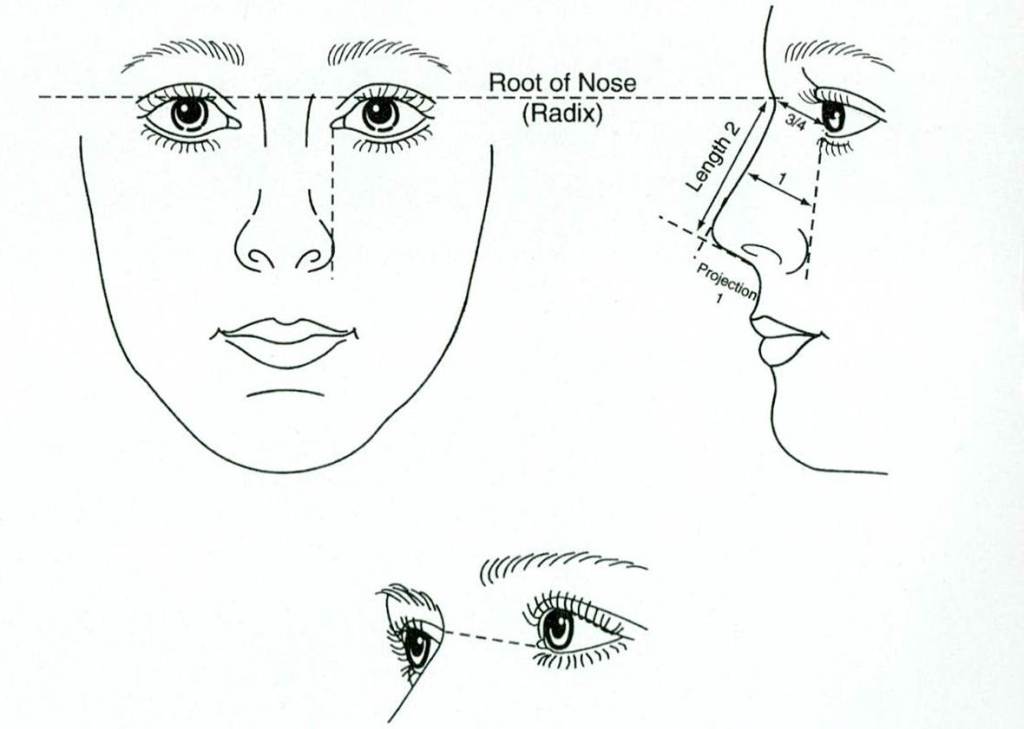
Figure 2. The four measurements and their ratio. Radix, dorsum, and tip heights are measured relative to the line connecting the medial canthus and alar crease; nasal length extends from the radix to the tip. Source: McKinney 2002, Fig. 1.
How Are Korean Nasal Proportions Different?
A study applying the same measurement system to Korean adults reported an approximate ratio of 2 : 0.97 : 0.61 : 0.28.
The nasal tip projection was relatively close to the Western reference value. The larger differences appeared in dorsal height and, most noticeably, radix height—the point where the bridge begins between the eyes.
This does not mean every Korean patient should have the bridge raised to Western proportions. The measurements describe population averages; they do not prescribe an ideal result. A natural plan interprets the numbers in relation to the patient’s forehead, midface, mouth, chin, skin, and cartilage.
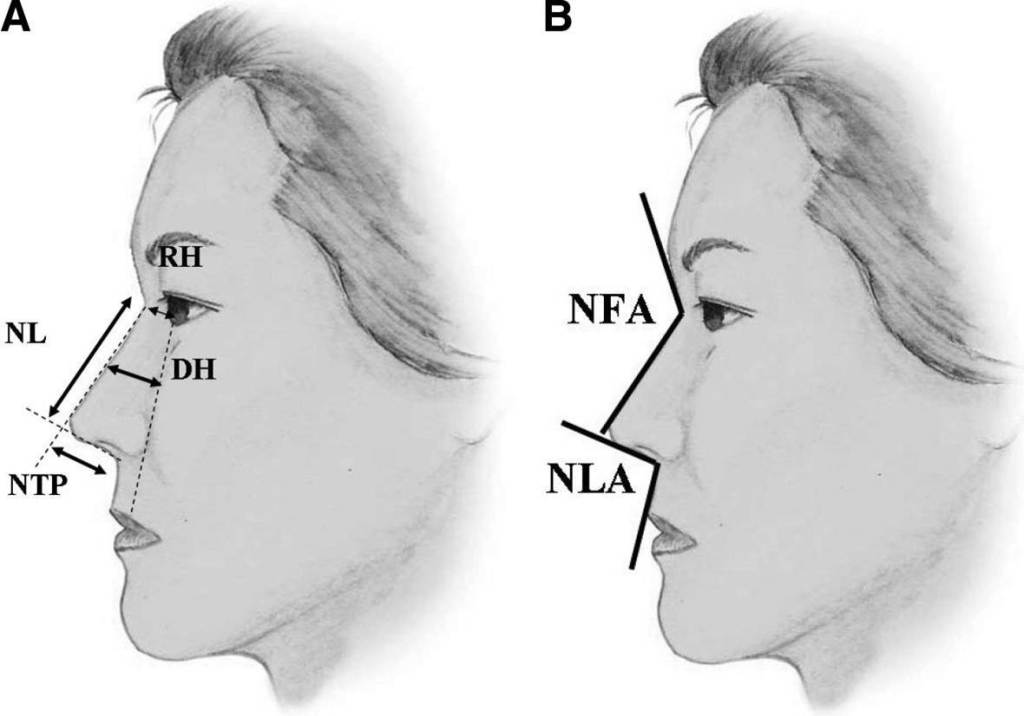
Figure 3. Measurement method applied to Korean adults: NL, nasal length; NTP, nasal tip projection; DH, dorsal height; RH, radix height; NFA, nasofrontal angle; and NLA, nasolabial angle. Source: Wang 2009, Fig. 1.
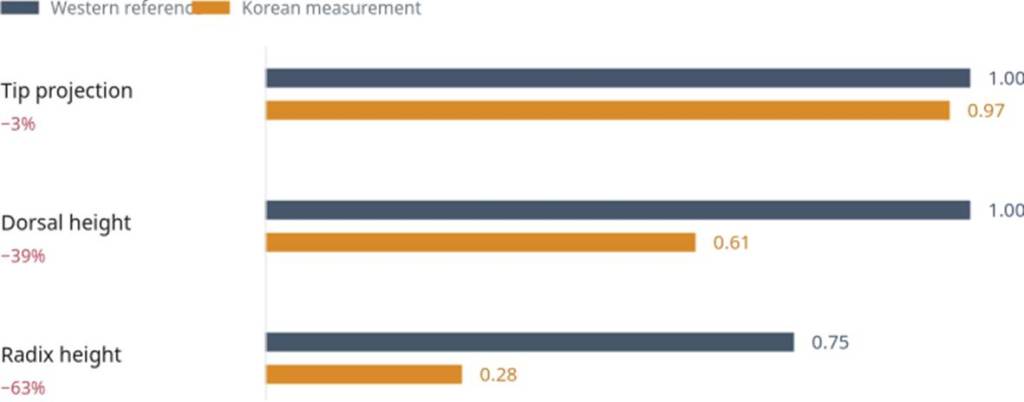
Figure 4. Values obtained when nasal length is normalized to 2. Tip projection is nearly identical, while the larger differences occur at the dorsum and radix. Data: Wang 2009 (Korean adults) vs. McKinney 2002.
What Did 321 Korean Adults Prefer?
Measurements describe anatomy, while preference studies ask a different question: what do people actually find attractive? In a Korean photo-analysis study of 321 adults in their twenties and thirties, participants selected among several variations of the nasal bridge, radix, tip, and base view.
The clearest preference was for a straight dorsal profile; 61% of women selected the straight bridge. Participants also tended to prefer a lower, shallower radix than classic Western reference values. By contrast, preferred tip projection and tip angle were relatively close to traditional reference ranges.
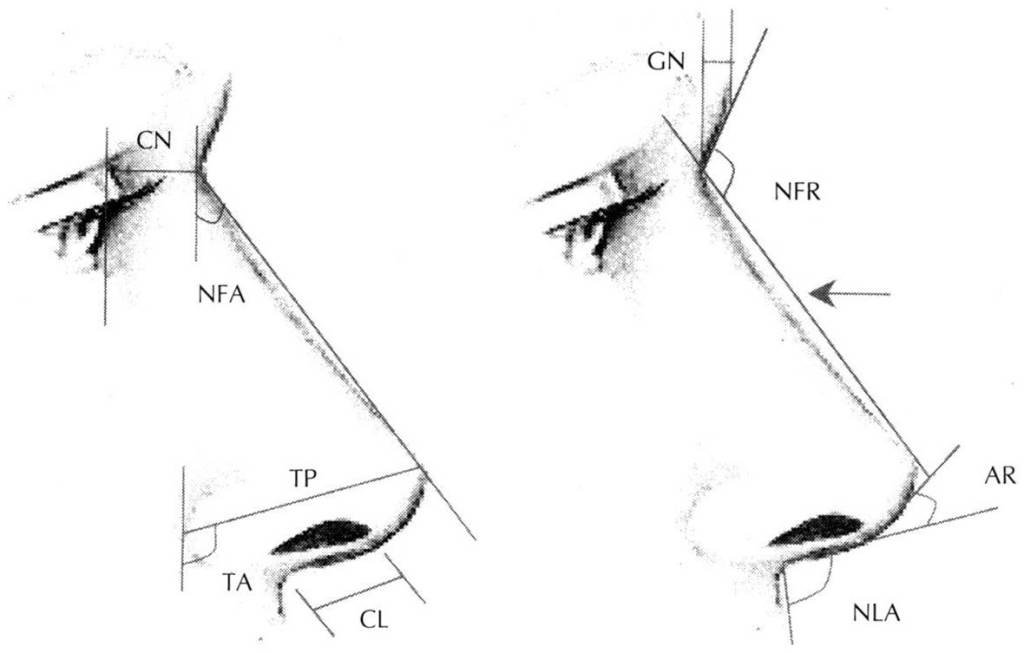
Figure 5. Profile variables used in the Korean preference survey: radix height and depth, nasofrontal angle, tip projection and rotation, and nasolabial angle. Source: Yun 1998, Fig. 2.
The base-view findings are equally important. Women tended to prefer a narrower alar base and narrower bridge, while men and women selected the same nasal tip angle of 65 degrees. In practical terms, narrowing the alar base is not the same operation as narrowing the tip, and the two should not be treated as interchangeable goals.
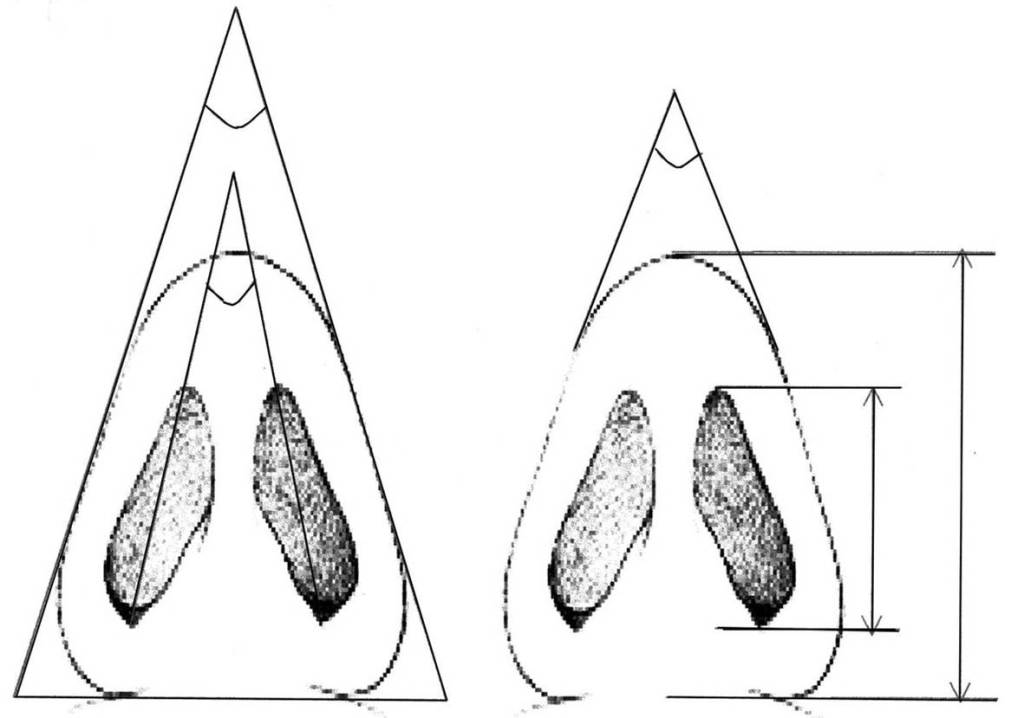
Figure 6. Basal-view variables: alar-base apex angle, tip apex angle, nostril-length ratio, and the angle between the two nostril axes. Source: Yun 1998, Fig. 4.
Where the Nose Is Raised Matters More Than How Much
Patients often ask how many millimeters their bridge should be raised. The amount matters, but the location of the change may matter even more.
Raising the radix can define the upper bridge, but it can also make the nose appear longer. As the bridge becomes higher, the existing tip may look less projected by comparison. This is why the radix, bridge, nasal length, and tip projection should be planned together.
If every measurement is increased toward a Western reference model, the result may look too large or too long on an Asian face. The goal is a continuous transition through the forehead, radix, bridge, tip, upper lip, and chin.
The Nasal Tip Cannot Be Evaluated by Itself
The same nasal tip can look prominent, droopy, short, or under-projected depending on the surrounding facial structure.
A retruded chin can make the nose appear larger even when the tip is in a reasonable position. Insufficient midface projection can make the nose look isolated from the face, while depression around the nasal base can change the apparent relationship between the columella and upper lip.
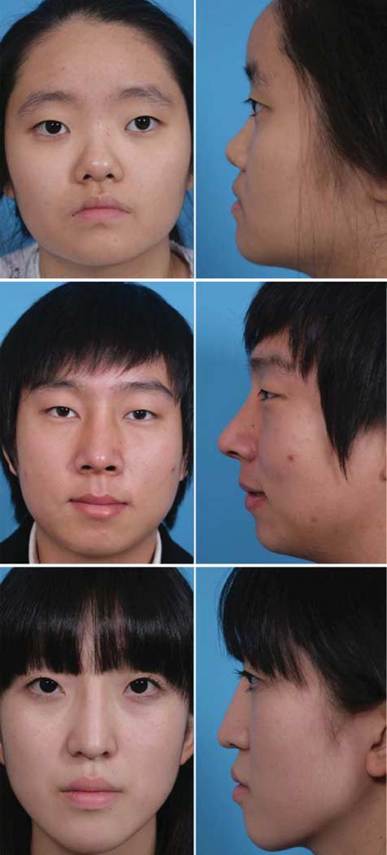
Figure 7. Nasal tip rotation from top to bottom: over-rotated, ideal, and under-rotated. Mean nasolabial angles were 88.6°, 87.1°, and 80.4°, respectively. Source: Choi 2013, Fig. 2.
One Asian facial-analysis study found that the nose–chin relationship had substantially more influence on the perceived ideal tip position than the nasolabial angle. This is why an apparently droopy or prominent tip should not be assessed without first examining chin projection.
For that reason, rhinoplasty planning should evaluate the forehead, midface, nasal base, lips, and chin—not only the nose. Additional procedures are not necessary for every patient, but the complete profile should be understood before deciding how much to raise or lengthen the tip.
The Nasolabial Angle: A Common Source of Misunderstanding
The nasolabial angle is formed where the columella meets the upper lip. It is often treated as a measurement of tip rotation, but it is influenced by several structures.
- The position and support of the columella
- The strength and length of the septal cartilage
- The projection of the anterior nasal spine
- Upper-lip and dental projection
- True nasal tip rotation
In some East Asian patients, reduced support beneath the columella and upper-lip projection can produce an acute nasolabial angle even when the tip itself is not significantly under-rotated.
If weak support is mistaken for a tip-position problem, rotating the tip upward may shorten the nose and expose more of the nostrils. The surgeon must first identify whether the main issue is columellar support, lip projection, tip rotation, or a combination of factors.
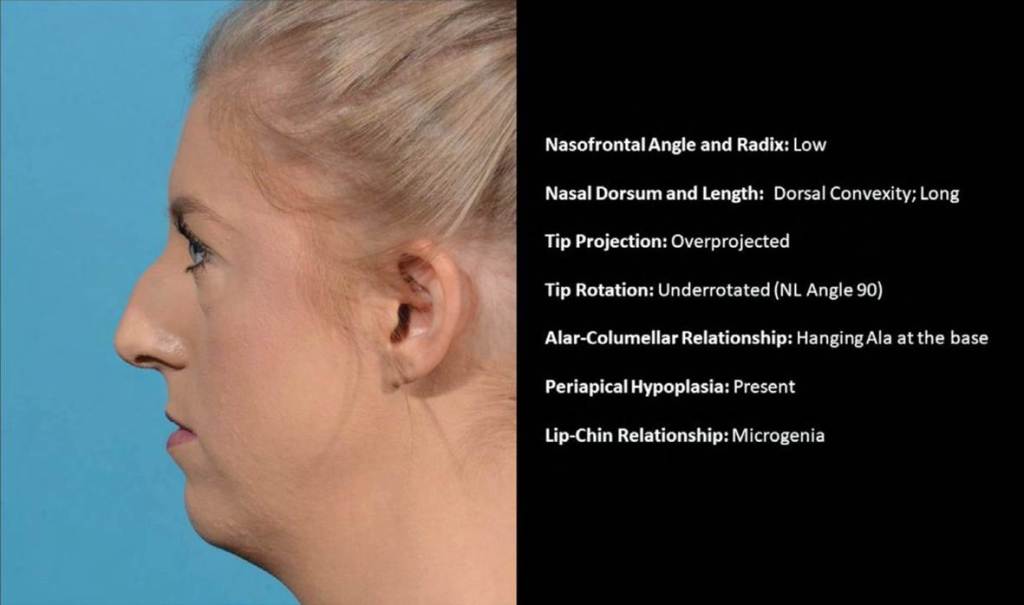
Figure 8. Example of profile analysis showing a low radix, convex dorsum, periapical hypoplasia, and microgenia. It demonstrates how the apparent nasal tip position is influenced by structures outside the nose. Source: Brito 2020, Fig. 2.
What Can the Base View Tell Us?
The base view helps evaluate nostril shape, columellar position, tip symmetry, and the relationship between the lobule and nostrils. Traditional reference diagrams often describe a triangular base and teardrop-shaped nostrils, but real treatment planning must account for individual anatomy and ethnicity.
Why Can a Nose Look Operated Even When the Numbers Are Correct?
A nose may match standard ratios and angles yet still appear artificial. The reason is usually not a number. It is the surface contour.
The nose is composed of multiple small surfaces created by underlying bone and cartilage. Light moving across those surfaces creates the lines, highlights, and shadows that we recognize as definition. If the framework is too narrow, too wide, uneven, or overly rigid, the skin may reveal pinching, asymmetry, visible edges, or an implant-like appearance.
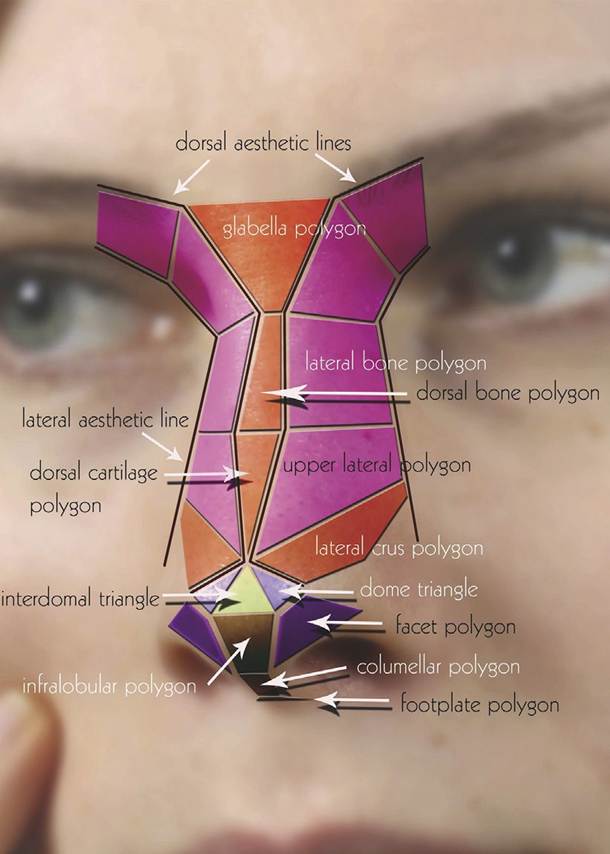
Figure 9. The nasal surface divided into multiple aesthetic polygons. The lines and points perceived on the nose are created where these surfaces meet; even soft spaces that disappear when the skin is lifted contribute to the overall contour. Source: Çakır 2016, Fig. 5.
What Are the Dorsal Aesthetic Lines?
The dorsal aesthetic lines are the two light-reflecting lines seen along the bridge from the front. In a natural nose, they are not perfectly parallel from top to bottom.
- They begin relatively narrow near the radix.
- They widen gently through the middle bridge.
- They narrow again just before the tip.
- They open softly as they transition into the tip.
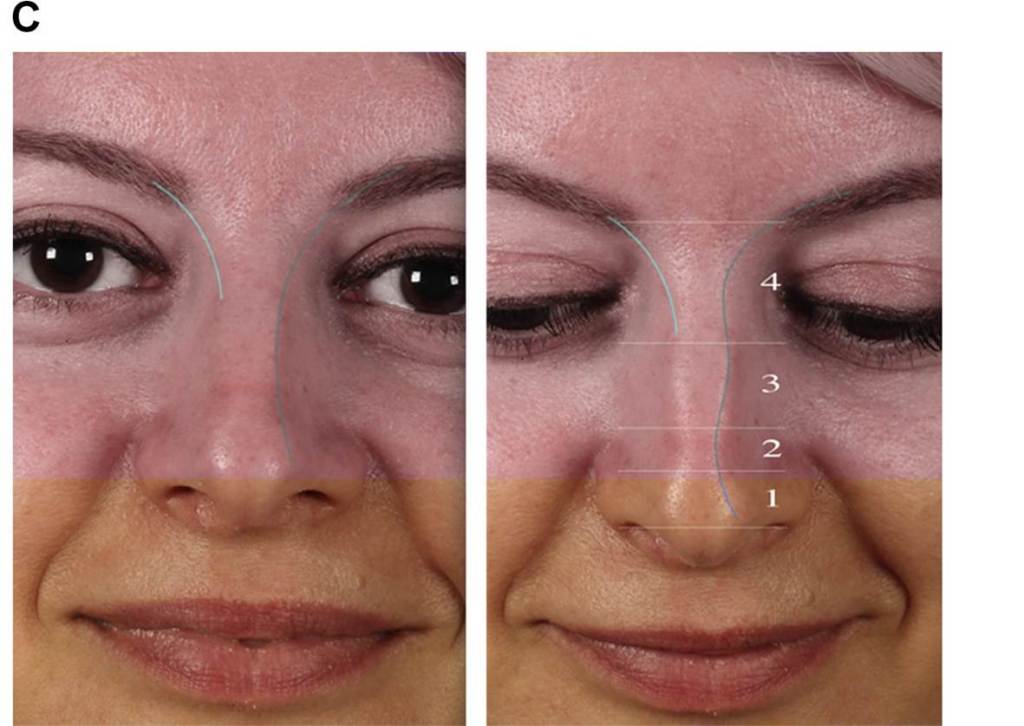
Figure 10. Frontal dorsal aesthetic lines. The spindle-shaped pattern on the right begins narrow at the radix (1), widens through the middle vault (2), narrows before the tip (3), and opens again at the tip (4). Source: Çakır 2016, Fig. 10C.
When these lines are excessively narrow, the bridge may look pinched. When they are too wide or poorly defined, the nose can appear heavy. A small interruption or difference in width may also make asymmetry more visible.
The Nasal Tip Is Not One Round Structure
A refined nasal tip is formed by several small surfaces. Together, they create a controlled highlight—often described as diamond-shaped—with subtle shadowed areas beside the tip.
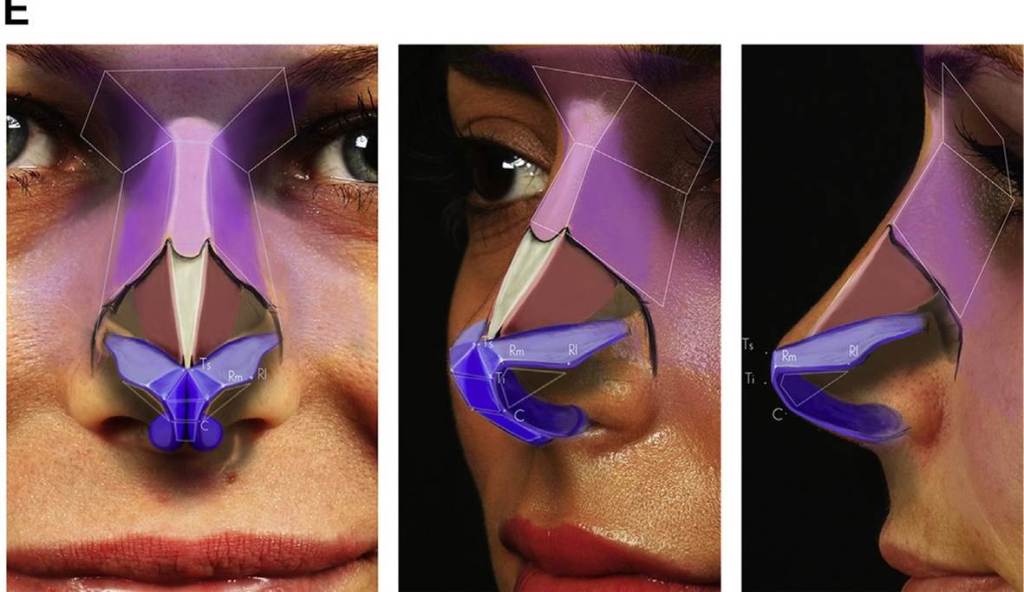
Figure 11. The light-reflecting surfaces of the nasal tip. Two domes, the central triangle, and the adjacent shadow spaces combine to form a diamond-shaped highlight. Source: Çakır 2016, Fig. 12E.
These highlights cannot simply be drawn onto the skin. They result from shaping and supporting the cartilage beneath the soft-tissue envelope. Skin thickness, scar tissue, soft-tissue volume, and cartilage strength all influence how clearly the final definition appears.
Natural Does Not Mean Perfect—It Means Free of Distracting Deformities
A long-standing rhinoplasty debate asks whether mathematically ideal proportions can make a nose look operated. A more useful conclusion is that the artificial impression usually comes from recognizable contour problems rather than from proportion alone.
Common features that can create an operated appearance include:
- A pollybeak contour, where fullness develops above the tip
- An overly narrow middle vault with harsh shadowing
- An over-resected or excessively scooped bridge
- A pinched nasal tip
- Retracted or unnaturally elevated alar rims
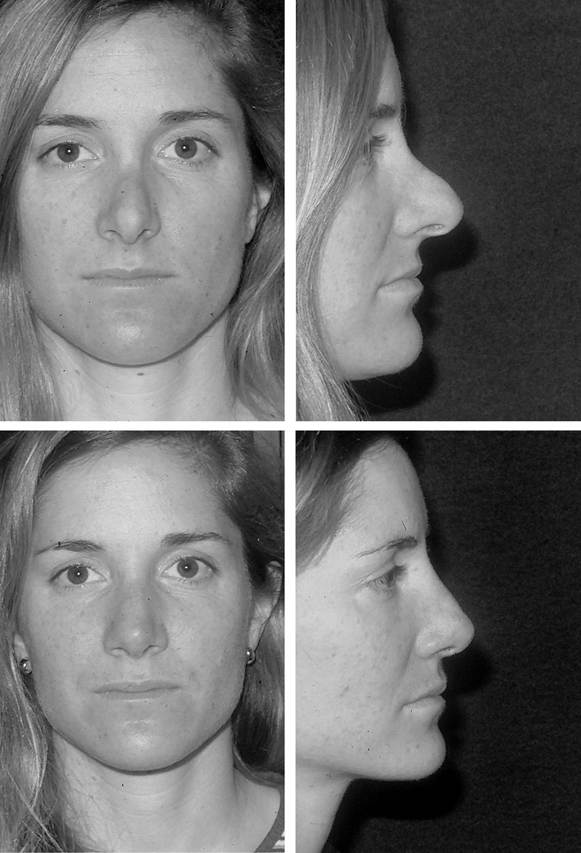
Figure 12. Example of a pollybeak deformity. The upper images show the preoperative condition, and the lower images show the result 13 months after revision surgery. The operated appearance is caused by the deformity, not by proportion alone. Source: Gruber discussion in Chait 2000, Fig. 1.
The preferred height or tip definition can vary from person to person. The need to avoid unstable support, abrupt transitions, pinching, and visible contour irregularities is far more consistent.
An Evidence-Based Consultation Looks Beyond One Number
Modern nasal analysis systems evaluate multiple features rather than relying on a single angle. A detailed consultation may include the following:
- Nasal length and tip projection
- Radix and bridge height
- Tip rotation and columellar support
- Nostril shape and frontal nostril visibility
- Dorsal aesthetic lines and asymmetry
- Skin thickness and cartilage strength
- The relationship among the forehead, midface, lips, and chin
- Internal nasal obstruction and breathing
For revision rhinoplasty, the evaluation should also consider scar tissue, remaining cartilage, previous implants or grafts, and the stability of the septal support structure. Photographs and 3D simulations are helpful planning tools, but they do not replace a physical examination.
A 3-Minute At-Home Photo Check
This simple review is not a diagnosis, but it can help patients describe their concerns more clearly before a consultation. Use one straight-on photograph and one true profile photograph.
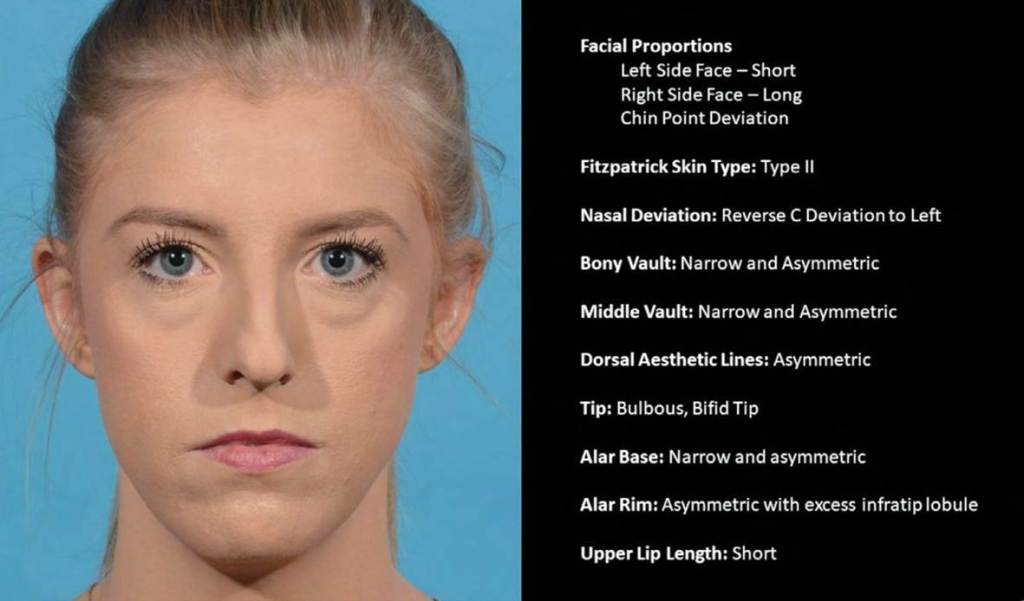
Figure 13. Example of frontal nasal analysis. Review alar width relative to the intercanthal distance, the symmetry and shape of the dorsal lines, tip form, and alar-rim contour. Source: Brito 2020, Fig. 1.
- From the front, compare alar width with the distance between the inner corners of the eyes.
- Follow the two dorsal aesthetic lines and check whether they are smooth, balanced, and gently spindle-shaped.
- Look at the tip as a set of small highlights and shadows rather than one round point.
- From the profile, assess the forehead-to-radix transition, bridge contour, tip projection, upper lip, and chin together.
- From the base view, note nostril shape, alar symmetry, columellar position, and frontal nostril show.
The goal is not to score the nose against a universal beauty chart. It is to identify which features are already balanced, which features are structural concerns, and which preferences should remain flexible.
Frequently Asked Questions
What is the most natural-looking nose shape?
There is no single natural-looking shape for everyone. A natural nose has appropriate height, length, projection, and transitions for the patient’s own face.
Is a higher bridge always more attractive?
No. A bridge that is too high, particularly near the radix, can make the nose look longer or artificial. Bridge height should be coordinated with the forehead, tip, lips, and chin.
What is the ideal nose ratio?
A traditional Western reference is 2 : 1 : 1 : 0.75 for nasal length, tip projection, dorsal height, and radix height. Korean measurements show different average values, so these numbers should be used as references rather than fixed surgical goals.
Why is Asian rhinoplasty different?
Asian rhinoplasty may require consideration of a lower radix or bridge, thicker skin, different cartilage strength, short-nose anatomy, and reduced columellar support. The operation should be individualized rather than determined by ethnicity alone.
How can I avoid an unnatural or operated appearance?
Choose a plan based on facial harmony and structural stability rather than maximum height or sharpness. Smooth transitions, natural dorsal lines, stable tip support, and respect for skin thickness are essential.
Can photographs determine my final surgical plan?
Photographs can support a preliminary assessment but cannot reveal cartilage strength, internal scar tissue, skin mobility, or breathing obstruction. A final plan requires an in-person examination and, when indicated, imaging such as CT.
Final Thoughts
Ideal nasal measurements are useful guides, but they are not a universal answer.
Natural rhinoplasty is not about forcing every face to match predetermined numbers. It is about preserving the features that are already balanced and correcting only the areas that are excessive, deficient, asymmetric, or structurally unstable.
The most useful question is not simply, ‘How many millimeters should my nose be raised?’ A better question is, ‘What height, length, projection, and contour will look most natural on my face?’
At DL Plastic Surgery in Seoul, rhinoplasty planning considers the relationship between the forehead, radix, bridge, tip, lips, and chin, as well as skin thickness, cartilage strength, breathing, and previous surgical history.
The final surgical plan should always be determined through an individualized consultation and physical examination.
Medical Disclaimer
This article is provided for general educational purposes and does not replace an in-person medical evaluation. Rhinoplasty results, surgical methods, recovery, and potential risks vary according to anatomy, health, skin condition, cartilage strength, and surgical history. Possible complications include bleeding, infection, inflammation, scarring, asymmetry, breathing changes, graft-related problems, and the need for revision surgery.

