
Beyond the K-Beauty V-Line: Why Facial Harmony Matters More Than Size
DL PLASTIC SURGERY | MEDICAL JOURNAL
Small faces, delicate jawlines, and defined V-lines are everywhere in Korean dramas, K-pop, and social media. Inspired by these K-beauty trends, many international patients consider traveling to South Korea for facial contouring surgery.
But is a smaller face really better for everyone?
What if reducing your facial width actually makes you look older? What if your naturally attractive cheekbones and facial definition begin to disappear?
The goal of facial contouring is not simply to make your face smaller. It is to create a more harmonious appearance while preserving the features that make you unique.
1. Is the Korean V-Line Right for You?
In South Korea, beauty trends often emphasize smaller faces, softer cheekbones, and smooth, tapered jawlines.
Meanwhile, prominent cheekbones, defined jawlines, and sculpted facial features are often celebrated in Western beauty trends. Of course, beauty preferences vary across cultures and individuals.
Even the same V-shaped jawline can create completely different impressions depending on the proportions of the eyes, nose, lips, facial length, and cheekbone structure.
For example, many Western patients have a higher, more projected nose. In these faces, a chin positioned slightly more forward than the typical Korean standard often creates a more balanced side profile.
Similarly, keeping a little more definition at the jaw angle below the ear, rather than making it completely smooth, often looks more natural and attractive.
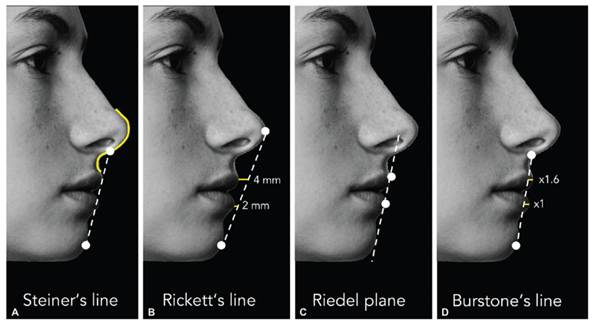
Classic guides for evaluating the balance of the nose, lips and chin in profile.
Many Western patients also prefer cheekbones with more volume at the front, like a full, rounded apple cheek, rather than a flat cheek.
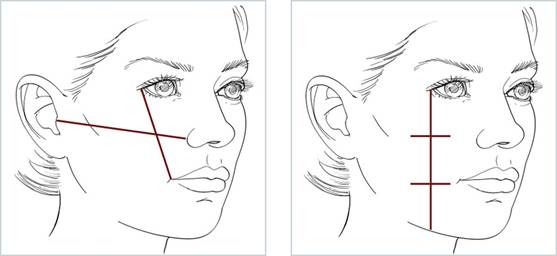
Classic guides to a balanced cheekbone highlight position: Hinderer analysis (left) and Wilkinson analysis (right).
Rather than trying to recreate the face of a celebrity or an influencer, it is important to discover what works best with your own anatomy.
Having plastic surgery in Korea does not mean you need to look Korean.
2. Smaller Doesn’t Mean Older: Volume and Line Keep a Face Youthful
A face does not look older simply because it is smaller. What matters is how it is made smaller.
Your facial bones do more than determine the size and shape of your face. They also provide structural support for the skin, fat, muscles, and surrounding soft tissues.
Excessive bone reduction without sufficient consideration of facial anatomy and skin elasticity may contribute to:
- Hollow-looking cheeks
- More noticeable facial sagging
- Loss of natural facial definition
- Imbalance in facial proportions
- A more aged or mature appearance
These changes do not occur in every patient. They usually come from removing too much support, not from having a smaller face. That is why we evaluate not only the facial bones but also skin elasticity, fat distribution, and soft-tissue condition.
Reposition, Don’t Just Reduce
At DL Plastic Surgery, we keep bone removal to a minimum and focus on repositioning instead. The cheekbone is moved inward to narrow the face, with the highlight placed in a balanced position and the bone that supports the cheek preserved.
By considering volume and highlight together, the face can be made slimmer naturally while keeping the fullness that makes it look youthful.
The result is a face that is slimmer, yet still youthful and balanced, with soft volume and clean lines working together.
A youthful appearance is not determined by facial size alone. Volume, support, and proportion matter just as much.


3. Do Beautiful Cheekbones Really Need to Be Reduced?
Not all prominent cheekbones need to be reduced.
High cheekbones and natural anterior cheek volume can add dimension, definition, and attractiveness to the face.
Cheekbone height and lateral projection are different anatomical features. Understanding this distinction is essential when planning cheekbone reduction surgery.
For example, it may be appropriate to reduce excessive lateral cheekbone projection while preserving the natural fullness and definition of the anterior cheeks.
| Often reduced | Often preserved |
| Excessive width at the side of the cheekbone | Natural fullness at the front of the cheek |
| A prominent, angular appearance | Facial definition and youthful volume |
Two patients undergoing similar cheekbone reduction procedures may achieve very different results depending on their original facial structure and soft-tissue volume.
Sometimes, knowing what to preserve is more important than knowing what to reduce.
4. Will Facial Contouring Make Everyone Look the Same?
International patients considering facial contouring in Korea may have concerns such as:
“Will I still look like myself after surgery?”
“Will my chin become too pointed or unnatural?”
“I want a slimmer face, but I don’t want to lose my natural facial definition.”
These are important questions.
Facial contouring should not be about creating the same V-line for every patient.
A soft, oval-shaped face may suit one person, while a more defined and sculpted jawline may complement another.
There is no single ideal face shape. Our goal is to find the shape that suits you best and reflects the look you want.
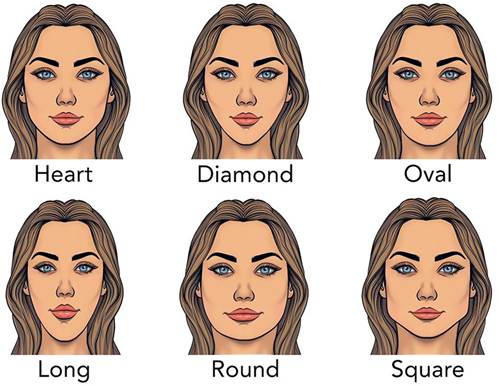
Different face shapes: heart, diamond, oval, long, round and square.
An individualized surgical plan should consider the patient’s natural facial characteristics, personal aesthetic preferences, and anatomical structure.
The objective is not to erase your identity, but to enhance your features in a way that feels natural to you.
5. How Does DL Plastic Surgery Approach Facial Contouring?
At DL Plastic Surgery, facial contouring focuses on overall facial harmony rather than simply reducing bone size.
Understanding Your Facial Structure Through 3D CT
3D CT imaging helps evaluate anatomical details that may not be visible in ordinary photographs, including cheekbone projection, jawbone structure, chin position, and facial asymmetry.
Combined with an in-person clinical examination, this assessment helps determine whether facial width is primarily related to bone, muscle, fat, or a combination of these factors.
Not every wide face needs bone surgery. Depending on the cause, other treatments may be more suitable:
| What makes the face look wide | What may help |
| Bone | Facial contouring surgery |
| Muscle (chewing muscle) | Botulinum toxin injections |
| Fat | Fat-reduction procedures |
| Sagging skin | Lifting procedures |
Planning the Movement, Not Just the Reduction
Facial contouring is not simply about how much bone can be removed.
The direction of bone movement, fixation, facial projection, and potential soft-tissue changes are also important considerations.
Surgical planning takes into account facial proportions from multiple perspectives, including the front, side, and three-quarter views.
Preserving Your Individual Beauty
Rather than applying a single beauty standard to every patient, DL Plastic Surgery considers each individual’s anatomy, natural facial features, and desired appearance.
Dr. Jinwook Jeong, M.D., Ph.D.
With a focus on facial contouring, rhinoplasty, and facial aesthetic surgery, Dr. Jeong emphasizes overall facial harmony and balance while actively participating in international academic exchange.
Dr. Sung Jae Ahn, M.D.
With experience in facial contouring, facial asymmetry correction, revision contouring, and lifting procedures, Dr. Ahn emphasizes anatomical assessment and individualized surgical planning.
6. What Should You Know Before Traveling to Korea for Facial Contouring?
Traveling abroad for plastic surgery is a significant decision. Beyond surgical costs, international patients must also consider flights, accommodation, recovery time, and postoperative care.
When choosing a clinic, look beyond before-and-after photographs and consider asking the following questions:
- Do I actually need facial bone surgery?
- Can my natural facial definition and unique features be preserved?
- Does the surgical plan consider the possibility of facial sagging or hollowing?
- How long should I stay in South Korea after surgery?
- What postoperative care will be available?
- Can I stay in contact with the clinic after returning home?
Temporary swelling, bruising, discomfort, and numbness may occur after facial contouring surgery. Potential complications also include asymmetry, infection, bleeding, nerve injury, and unwanted soft-tissue changes.
Understanding the expected changes, potential risks, and recovery process through a thorough consultation is an essential part of making an informed decision.
7. You Don’t Need a Korean Face. You Need a Face That Feels Like You.
Beauty has no single definition.
You can be inspired by K-beauty without sacrificing the features that make you unique.
Successful facial contouring is not about achieving the smallest face possible. It is about finding a harmonious balance that complements your natural beauty and individuality.
At DL Plastic Surgery, international patients can begin their journey with a preliminary online consultation before traveling to South Korea. The final surgical plan is determined following an in-person consultation and detailed clinical assessment.
Don’t Chase a Smaller Face. Discover Your Own Balance.
DL PLASTIC SURGERY
FOR YOUR DREAM LINE
SEOUL, SOUTH KOREA

