
How camera distance and angles change your facial proportions — and how to take accurate photos before an online consultation
Have you ever noticed that your nose looks bigger in selfies, your face looks asymmetrical, or your jawline seems to change completely from one photo to the next?
You are not imagining it. The camera can change how your facial proportions appear. Researchers who studied this effect compared a close-up smartphone camera to a “portable funhouse mirror.”
For international patients considering plastic surgery in Korea, this matters even more, because the first consultation often begins with photographs sent online.
1. Why Does Your Nose Look Bigger in Selfies?
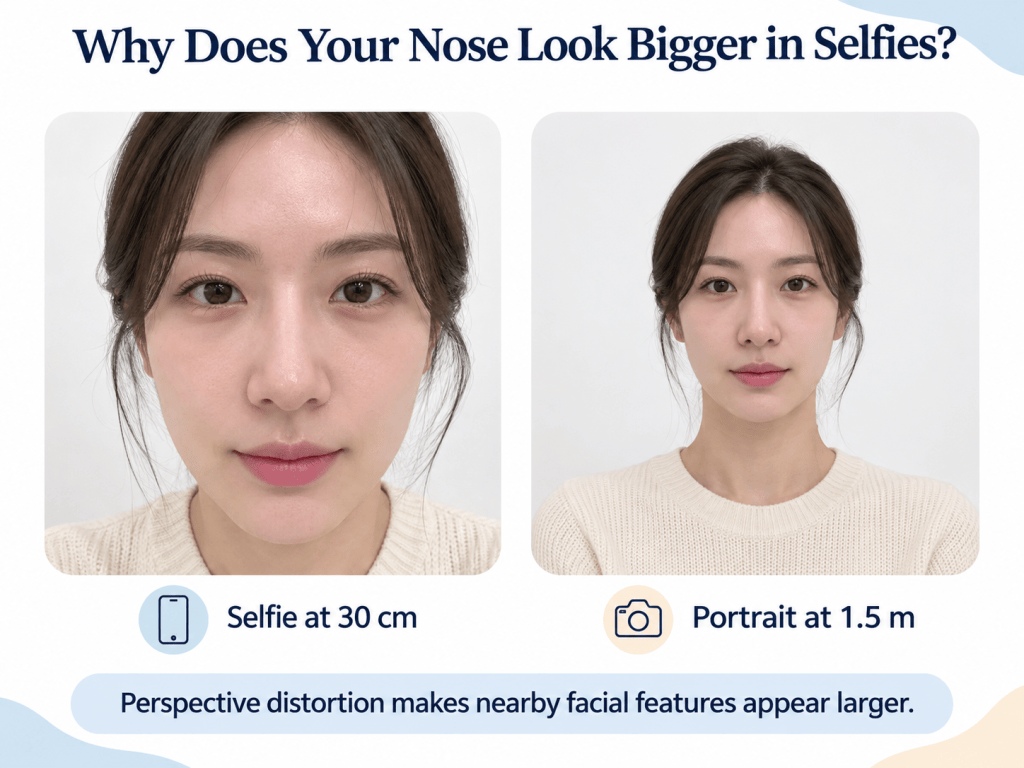
The main reason is perspective distortion. When a smartphone is held close to your face, the features nearest to the lens — especially the nose — appear larger compared with the rest of the face.
A study published in JAMA Facial Plastic Surgery used a mathematical model to compare a typical selfie taken about 30 cm (12 inches) from the face with a portrait taken about 1.5 m (5 feet) away. In the selfie, the base of the nose appeared about 30% wider, and the nasal tip about 7% wider.
Interestingly, the researchers began this work because many patients were showing their selfies as the reason they wanted a smaller nose.
This does not mean your nose is actually too large. It means a close-up photo may not show your real facial proportions.
2. How Camera Angles Change Your Face
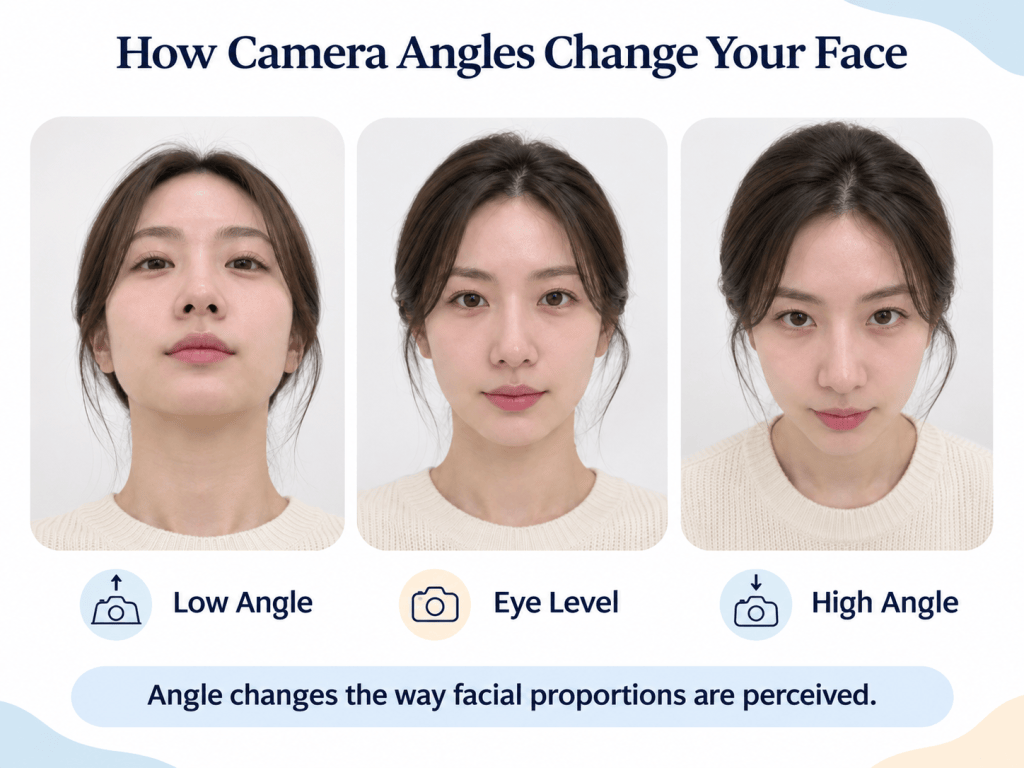
The nose is not the only feature affected. The position of the camera can change how your whole face looks.
- Camera too low: the nose and nostrils look more prominent, and the chin and jawline look heavier.
- Camera too high: the forehead and upper face look larger, while the lower face and chin look smaller.
- Camera too close: the nose and the center of the face look exaggerated, while the cheeks and ears seem to recede.
Lighting matters, too. Uneven shadows can make asymmetry, cheekbones and under-eye hollows look more noticeable than they really are.
This is why a feature that looks like a problem in one photo may look completely different from another angle — including a jawline that seems wide or a chin that seems long or short.
3. Can a Plastic Surgeon Evaluate Your Face from Photos?
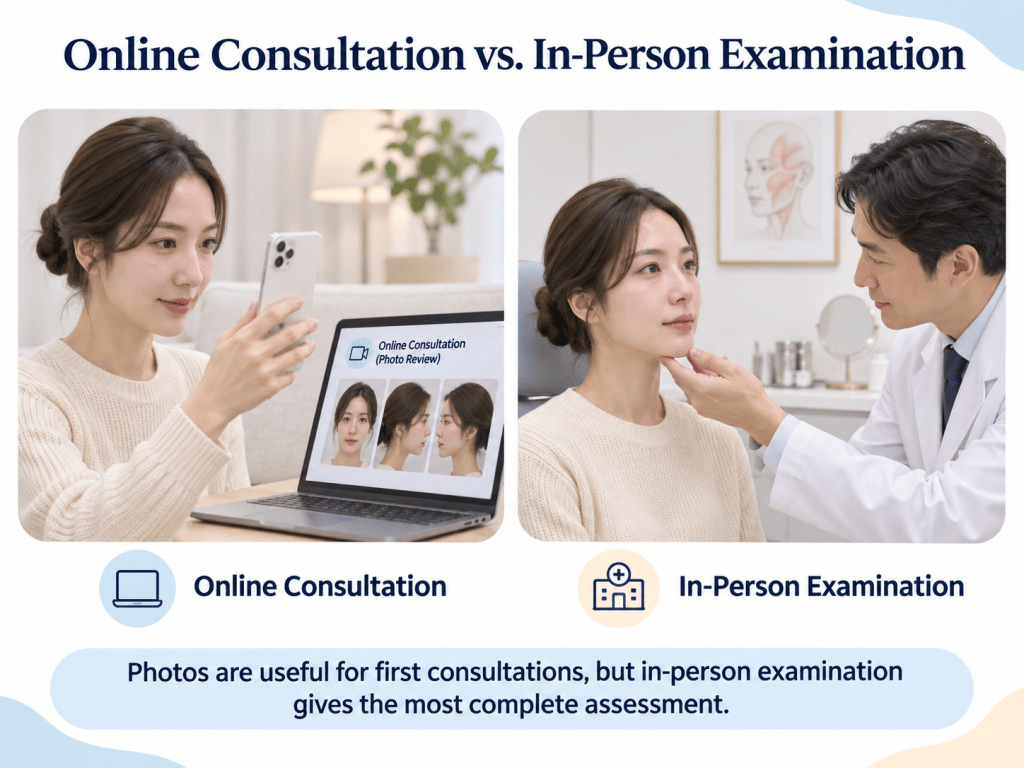
For international patients, an online consultation is a convenient first step before traveling to Korea. Good photos can help a surgeon understand your overall facial proportions, visible asymmetry and your main concerns.
However, photos alone cannot provide a complete medical assessment. A photograph cannot show the condition of the nasal cartilage, the internal structure of the nose, skin thickness and elasticity, or the shape of the facial bones.
This is especially true for facial contouring. A jaw that looks wide in a photo may be due to the bone, the masseter muscle, soft tissue, or simply the camera angle — and each needs a different approach.
At DL Plastic Surgery in Seoul, an online consultation helps you discuss your concerns and possible treatment options. The final surgical plan is made only after an in-person examination and, when needed, a 3D CT scan that shows the actual bone and structure of your face.
4. How to Take Accurate Photos for an Online Consultation?
Clear, consistent photos make your preliminary consultation much more useful. Here are six simple tips:
- Keep a proper distance. Ask someone to take the photo from about 1–1.5 meters away instead of taking a close-up selfie.
- Use the 2x lens, not the wide-angle lens. Most smartphones use a wide-angle lens by default. Switch to 2x (or a portrait lens) and avoid the 0.5x ultra-wide lens, which distorts the face the most.
- Use natural, even lighting. Face a window with soft daylight. Avoid strong shadows, overhead lights and direct sunlight.
- Keep the camera at eye level. Hold your head straight, look forward, and keep a relaxed, neutral expression.
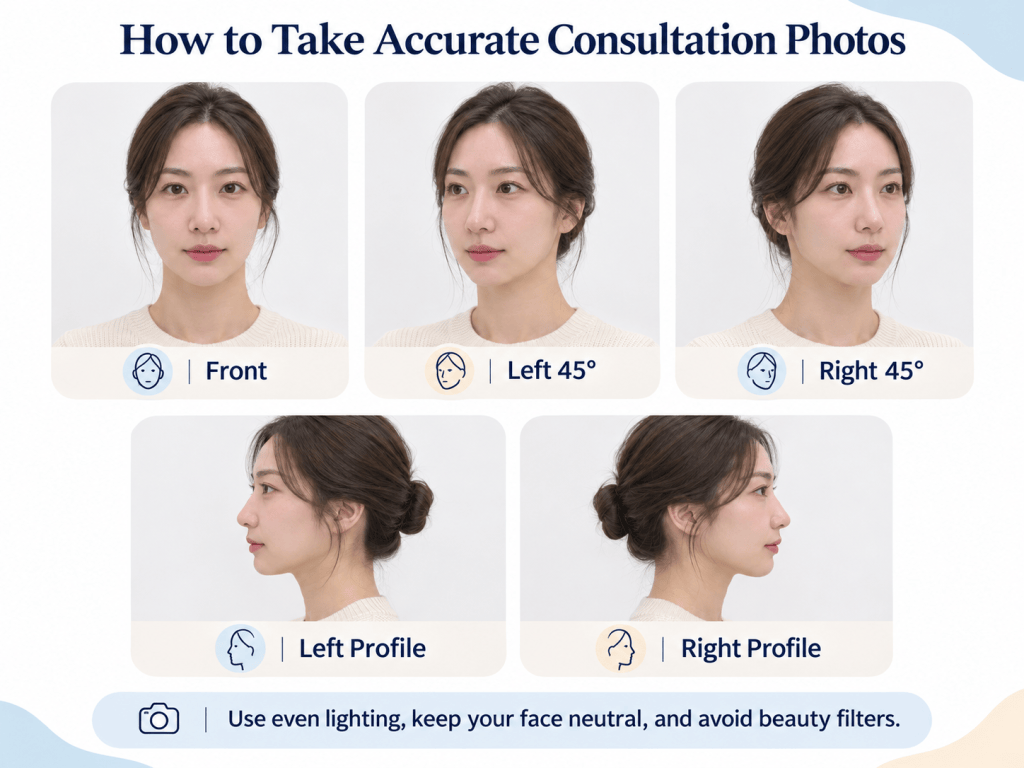
- Take multiple angles. Front view, left and right 45-degree views, and both side profiles. Pull your hair back so your forehead, ears and jawline are visible.
- Turn off filters and beauty effects. Skin smoothing, face slimming and automatic enhancement can hide important details.
Using the rear camera or a tripod also helps. Your photos do not need to look beautiful — their purpose is to show your natural face as it really is.
5. Why an In-Person Consultation Still Matters
Plastic surgery is not about changing how a feature looks in one photo. It is about understanding your real anatomy, the balance of your whole face, and the look you want to achieve.
For example, a patient may feel their nose is too large because of selfies, while an in-person evaluation shows that the nose is already in good proportion with the rest of the face. In that case, a good surgeon may recommend a smaller change — or no surgery at all.
In the same way, concerns about a wide jaw, a long chin or facial asymmetry should be evaluated with more than a single photograph.
At DL Plastic Surgery, we specialize in rhinoplasty and facial contouring. Every surgical plan is based on your facial anatomy, your individual proportions and your desired result — not on a selfie.
How to Start an Online Consultation with DL Plastic Surgery
- Send your photos (front, both 45-degree views and both profiles) together with a short description of your concerns via WhatsApp 10-5950-1157/ LINE dlps-eng / email: dreamlineprs@gmail.com.
- Receive a preliminary review with possible treatment options within 1-2 business days.
- Visit us in Seoul for an in-person examination and 3D CT analysis before your final surgical plan is confirmed.
Does my nose really look bigger in selfies?
Yes. In a typical selfie taken about 30 cm from the face, the base of the nose can appear about 30% wider than in a photo taken from 1.5 m. This is an effect of the camera, not your actual nose.
Can I get an accurate surgery plan from photos alone?
No. Photos are a helpful starting point, but cartilage, bone structure and skin cannot be fully assessed in a picture. Your final plan should be based on an in-person examination and, when needed, a CT scan.
What is the best way to take photos for a consultation?
Have someone take your photos from about 1–1.5 m away using the 2x lens, at eye level, in soft natural light, with no filters. Include front, 45-degree and profile views.
Final Thoughts
Your selfie is not always an accurate reflection of your face.
Before making a decision about plastic surgery based on a photo, it is important to understand how camera distance, angle and lighting change your appearance. Properly taken photos are a great place to start, but they should never replace a professional medical evaluation.
Considering rhinoplasty or facial contouring in Korea?
Send us your photos for an online consultation, and let DL Plastic Surgery help you understand which options truly fit your face.
Disclaimer: This article is for educational purposes only and does not replace an individualized medical consultation. Images are illustrative and do not show actual patients.

