
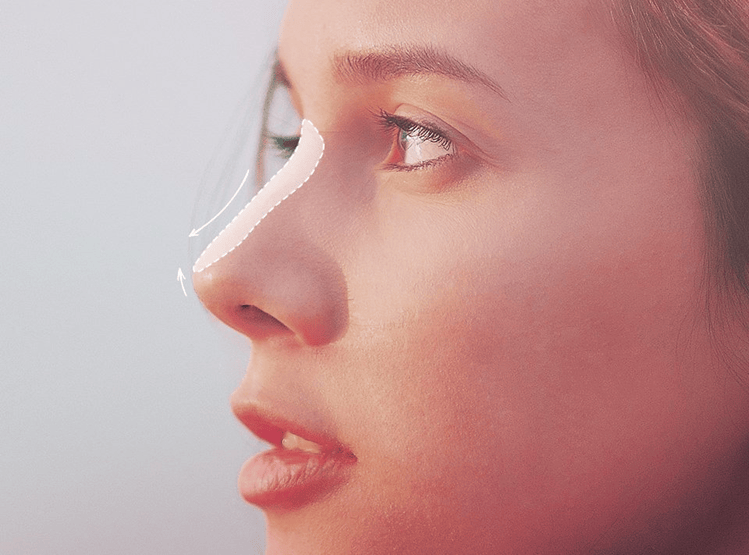
A 3D customized silicone nasal implant is a patient-specific bridge implant designed using CT-based anatomical data and a planned nasal profile. Its purpose is to improve fit and contour in augmentation rhinoplasty. It does not replace structural correction or guarantee a particular result.
Common consultation concerns include: “My bridge is higher, but the implant seems to sit away from the bone near the root of my nose.” “I think my implant is leaning to one side.” “I want a natural result, with definition starting at the nasal root.”
Every nose has a different shape, from the radix, or nasal root between the eyes, to the tip. Some people have a deep nasal root, others a slightly deviated nasal bone, a dorsal hump, or differences in height between the two sides. Almost no nose is perfectly symmetrical.
Conventional implants, however, are manufactured in predetermined shapes. Surgeons carve them by hand during surgery to improve the fit. Even careful carving may not produce an exact match to the contours of an individual patient’s nasal bones.
This column explains how customized nasal implants are designed, how they differ from conventional silicone implants, and when they may be considered. It also outlines their limitations and introduces customized diced rib cartilage as an alternative discussed in Part Two.
Why Conventional Nasal Implants May Not Sit Flush
Conventional implants are carved during surgery, relying on the surgeon’s tactile judgment. This is difficult to measure precisely, and the result can vary with the surgeon’s technique.
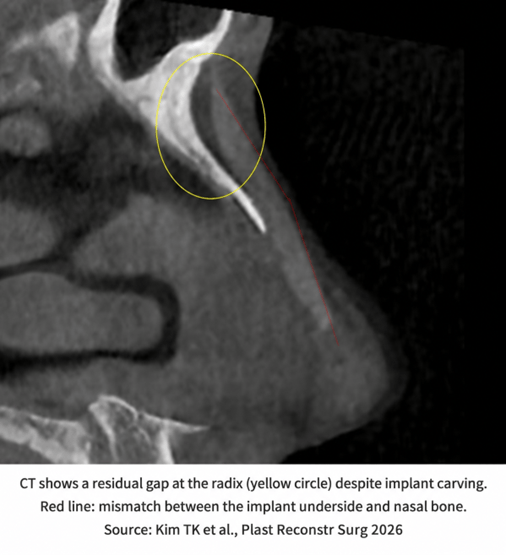
When a space remains between the underside of an implant and the nasal bone, several problems may arise.
- Tilting or rotation. Uneven support beneath the implant may allow it to lean or turn to one side.
- Visible implant edges. When the lateral margins do not sit against the bone, the outline can become noticeable and make the result look operated on.
- A thick capsule and inflammation. Blood or tissue fluid collecting in a residual space may contribute to capsule thickening and increase the risk of inflammation.
Implant malposition is a recognized concern in silicone augmentation rhinoplasty. Its likelihood depends on anatomy, implant design, surgical technique, and the patient population; a single rate should not be treated as an individual risk estimate.
A deep nasal root with an abrupt angle can be difficult to match by carving a conventional implant. The CT illustration shows a residual gap near the radix despite implant shaping. Fit must be assessed together with pocket preparation, soft-tissue coverage, and the overall surgical plan.
How 3D Customized Silicone Nasal Implants Are Made
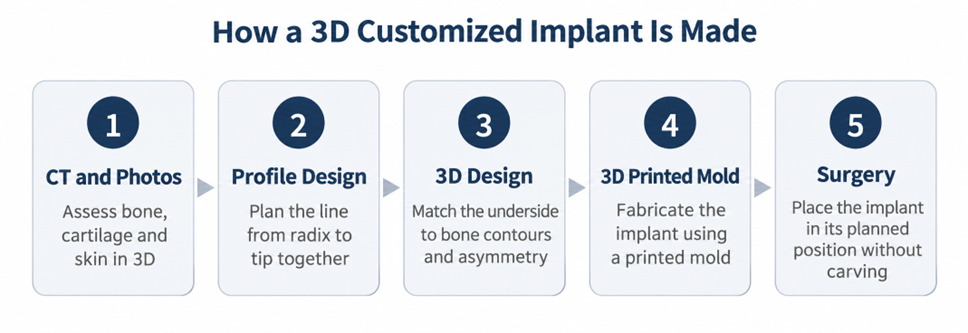
The process uses CT-based planning to design the implant underside around individual anatomy, while photographs and consultation help define the desired bridge profile. The mold can be 3D printed; this should not be confused with directly printing silicone in every manufacturing system.
1. CT imaging and photography. CT helps assess bony anatomy and asymmetry, while photographs and clinical examination complement the evaluation of the skin and soft tissues.
2. Designing the desired profile. The patient and surgeon draw the preferred line from the nasal root to the tip on photographs.
3. Three dimensional design. The implant’s underside is designed to accommodate the contours and asymmetry of the nasal bones, while also taking the planned tip surgery into account.
4. Fabrication using 3D printing. A mold is 3D printed to the design, and the implant is manufactured using that mold.
5. Surgery. The implant is positioned according to the surgical plan. The surgeon confirms the fit and decides whether any adjustment is needed.
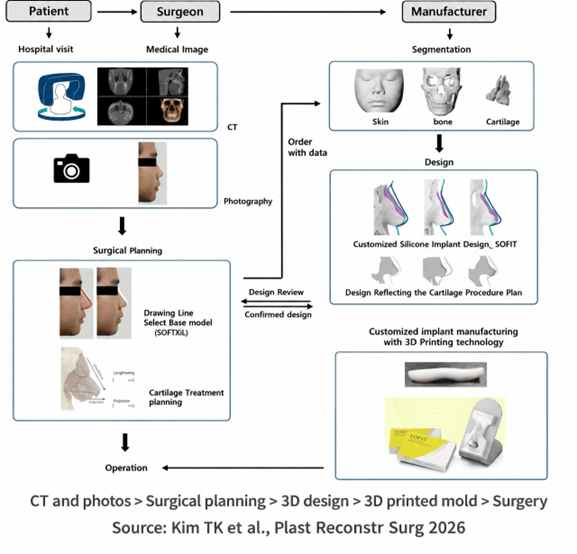
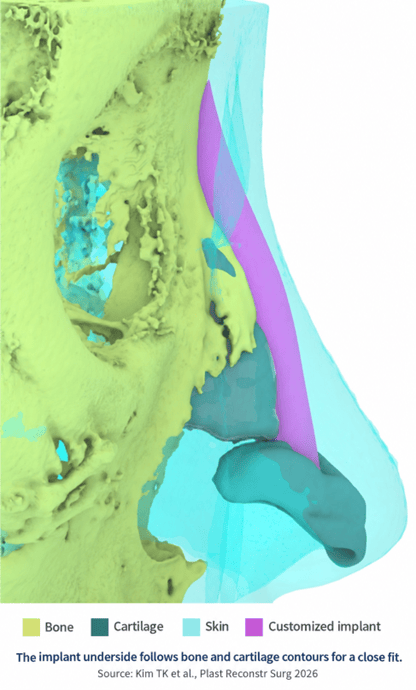
Before surgery, the customized implant is placed on a CT-derived 3D model to preview the intended bridge profile.
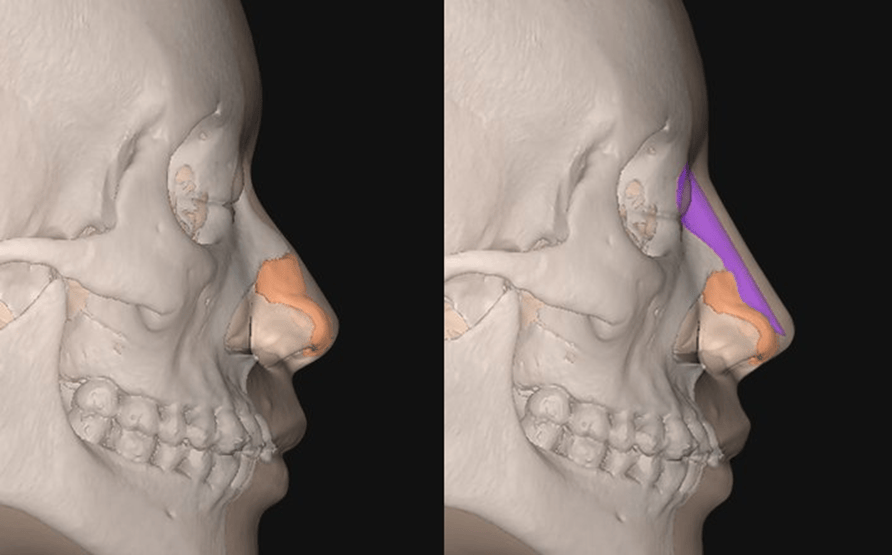
The key feature is the underside. The visible profile matters, but the implant is also made to follow the underlying bone and cartilage contours closely. More even support helps avoid concentrating pressure in one area and is intended to support stable positioning from the early postoperative period.
–
A preoperative simulation helps the patient and surgeon discuss height and contour more precisely. It is a planning aid rather than a prediction of the exact healed result: skin tension, swelling, scar formation, and tissue healing also affect the outcome.
What Research Shows About Customized Nasal Implants
Kim and colleagues compared customized and prefabricated silicone implants for mild dorsal deviation or a dorsal hump. Their 2026 report described greater improvement with customization in the following photographic measures [1].
- Dorsal deviation, describing the degree of bridge misalignment.
- Hump angle, describing the profile of a dorsal prominence.
These findings support customization as an option for selected mild dorsal irregularities. Camouflaging a contour does not straighten the underlying skeleton, and a pronounced hump or major deviation may still require structural surgery.
Suh and colleagues evaluated 50 patients with patient-specific nasal implants at one year using photographs and cone-beam CT. The study reported the following anatomical and planning findings [2].
- At one year, the implant remained parallel to the nasal bone, with an average separation of 0.71 mm in the sagittal view.
- The reported difference between simulated and postoperative profile measurements was approximately 0.01 mm over bone and 0.61 mm over cartilage.
- The authors described maintained anatomical alignment at one year. A one-year observation does not establish lifelong stability or eliminate the possibility of later complications.
Silicone does not resorb like a biological graft, but this does not mean that nasal shape will remain unchanged indefinitely. Position, capsule formation, the skin and soft tissues, and aging can influence long-term appearance. The 50-patient report is Level IV evidence and does not establish superiority for every patient [2].
Who May Be a Candidate for a Customized Nasal Implant
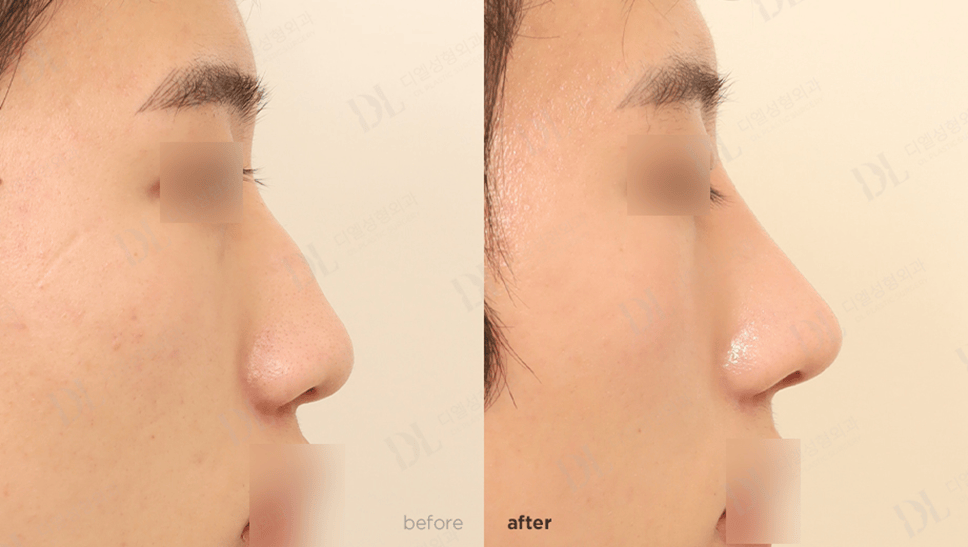
Men with a Deep Nasal Root
A deeply recessed radix with an abrupt angle can be difficult to fit with a conventional implant. A customized underside can accommodate that contour when the goal is a more defined nasal root and bridge. Suitability depends on examination and the desired profile rather than gender alone.
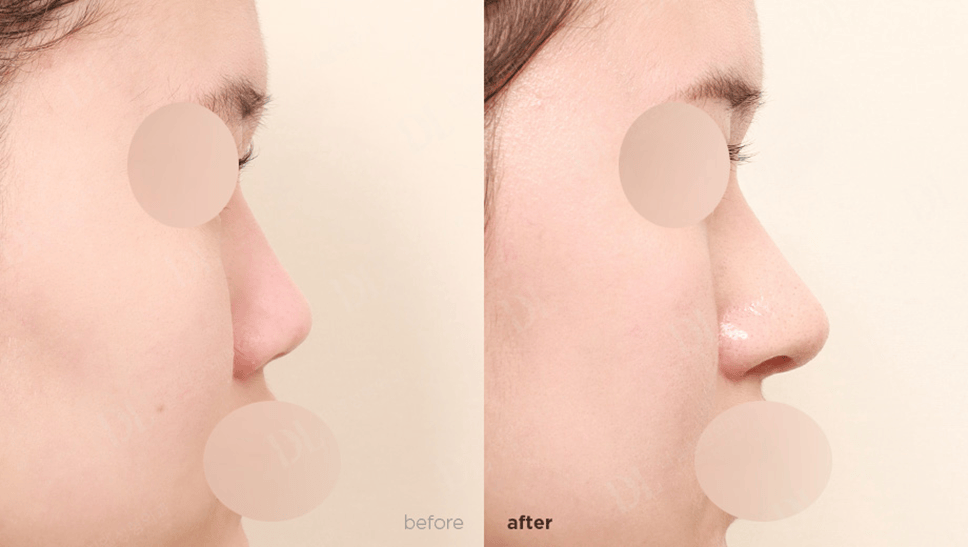
Women Seeking More Bridge Volume
Some patients prefer moderate volume from the radix through the dorsum rather than a narrow profile. Customized width and volume may help the surgeon plan edge transitions, but visible edges remain possible, particularly where soft-tissue coverage is limited.
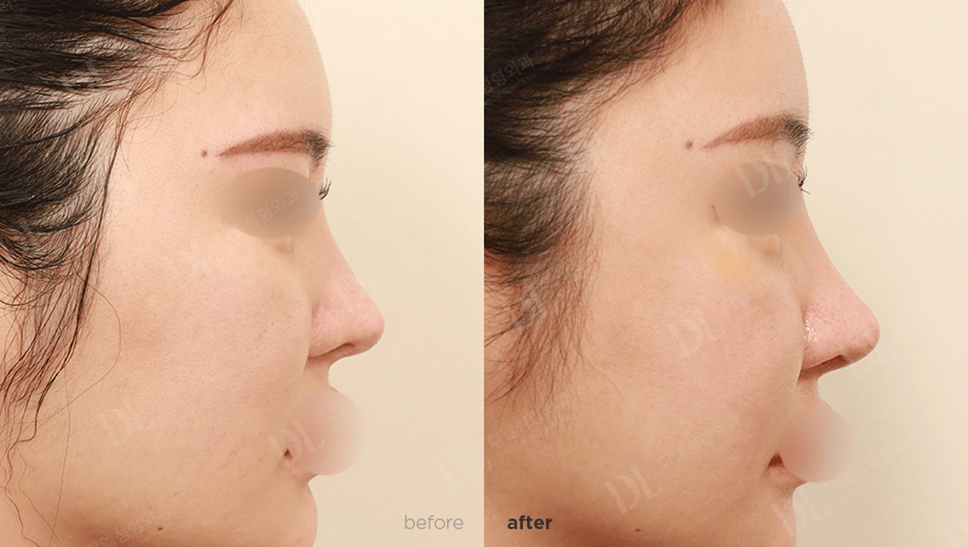
Mild Nasal Bone Deviation or Asymmetry
For selected mild asymmetries, the implant underside can be designed to accommodate the underlying contour and improve the apparent bridge line. Significant nasal deviation, breathing symptoms, or facial asymmetry requires a broader assessment; a custom implant alone may be insufficient.
What Customized Nasal Implants Cannot Correct
A customized silicone implant can augment the bridge, but it cannot solve every structural or healing problem. The plan must account for nasal breathing, skin coverage, the tip framework, and previous surgery.
- Marked deviation or a large hump may require more than an implant. Structural procedures, such as osteotomies to reposition the nasal bones or hump reduction, may also be necessary.
- Although 3D design can precisely model the fit to bone and cartilage, it cannot perfectly predict postoperative skin tension or scar contracture. These factors need particular attention in complex revision surgery with substantial scarring.
- Tip shape and support are planned separately, often using cartilage techniques. A predetermined bridge profile provides one planning reference, but the surgeon must assess the balance between the dorsum and tip during surgery.
When Diced Rib Cartilage May Be an Alternative
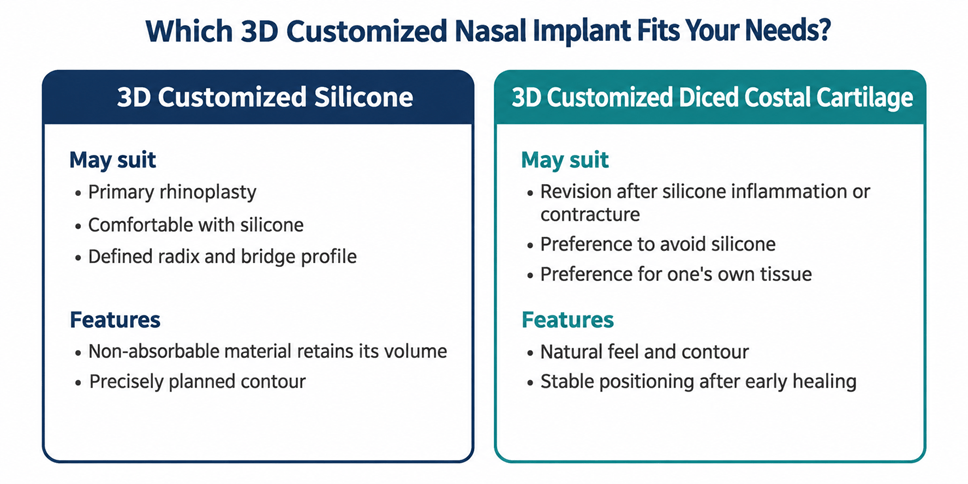
Three dimensional planning can also be used with a patient’s own diced costal cartilage, also called diced rib cartilage. Material selection depends on anatomy, tissue condition, previous complications, and the planned technique.
- For selected primary rhinoplasty patients who accept a synthetic implant, customized silicone may be one option for bridge augmentation. It is not automatically the best material for every first operation.
- Patients who prefer to avoid silicone, or who need revision following implant-related inflammation or contracture, may discuss autologous cartilage with their surgeon. Active infection and damaged tissues require assessment before choosing the material and timing of reconstruction.
Part Two will explain in detail how diced costal cartilage can be used to make a customized graft.
What to Ask at a Customized Nasal Implant Consultation
- Has CT been used to assess the nasal bone contours, radix depth, and asymmetry?
- Have you and your surgeon drawn the desired profile from the nasal root to the tip in advance?
- Will the underside of the implant be designed for your own nasal bones?
- Have you discussed whether substantial deviation or a large hump requires structural surgery, such as osteotomies?
- If you have a history of silicone-related inflammation or contracture, have you also discussed diced costal cartilage?
The goal is an implant and surgical plan that fit the individual anatomy, desired profile, and tissue conditions. General rhinoplasty risks include infection, breathing difficulty, scarring, an unsatisfactory appearance, and possible revision surgery [3].
Common Questions About Customized Nasal Implants
Is a customized nasal implant the same as a 3D printed mold
No. The design describes the implant, while the mold is a manufacturing tool. Ask how the final implant is fabricated and which material is used.
Can a customized implant replace osteotomies
Not in every case. It may accommodate selected mild surface irregularities, while substantial bony deviation may require osteotomies or other structural correction.
Does a 3D simulation guarantee the final nose shape
No. It helps communicate the plan, but healing, soft-tissue tension, and scarring can change the result.

