
The method and design of rhinoplasty vary depending on each patient’s skin thickness and tissue volume, facial proportions, and nasolabial angle.
In male rhinoplasty, the skin is generally thicker, and the cartilage and bone structure are larger than in female patients, which often requires a more complex surgical approach.
|Differences Between Male and Female Rhinoplasty – Male Autologous Rib Cartilage Revision Case
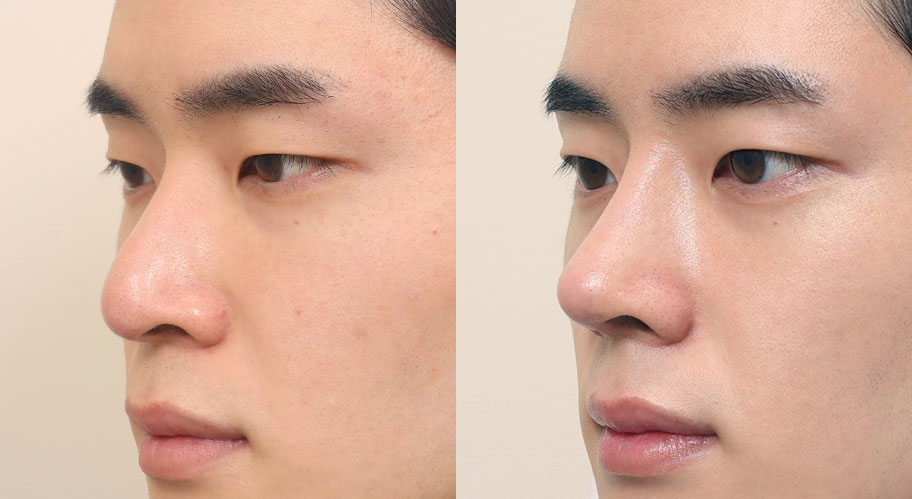
This male patient had undergone nose surgery a year ago at a different clinic, but was dissatisfied with the result and came to our clinic for revision.
His first surgery used donated rib cartilage, but soon after, he experienced drooping of the nose tip and occasional pain depending on his condition.
While donated rib has the benefit of not requiring harvesting and leaves no donor site scar, there is a risk of absorption or in rare cases, infection.
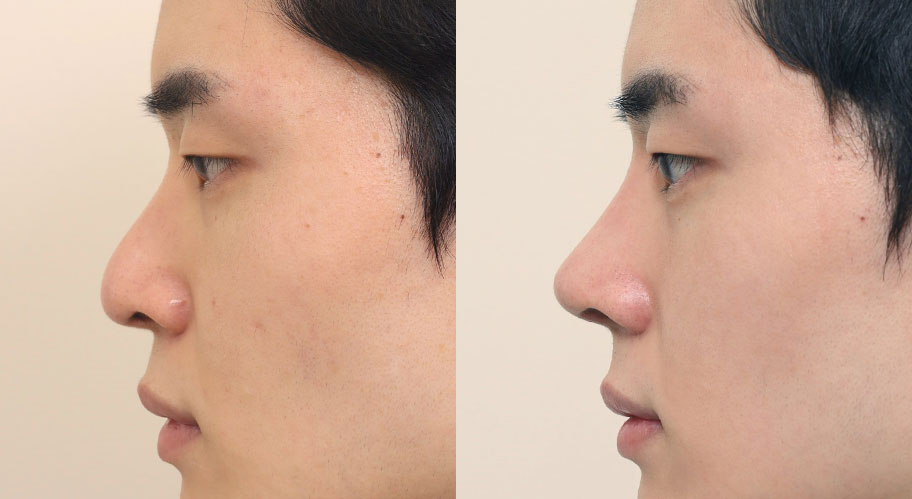
The patient felt that his nose tip appeared wider than before the first surgery and wanted to improve its shape.
Ultimately, he wished for a natural-looking nose that suits his facial features.
For this revision, we rebuilt the nasal structure using autologous rib cartilage, starting from the nasal base.

Male and female patients typically have different aesthetic goals:
Female patients tend to prefer a soft, curved line with a “straight-slope” or “slight curve” appearance.
In contrast, male patients often desire a strong, straight line that runs directly from the glabella to the nose tip, creating a bold and defined profile.

In this case, Dr. Jeong elevated the starting point of the nasal bridge and combined the procedure with alar wier reduction to eliminate any “droopy” or bulbous look.
Although there is still some swelling, you can already see that the revision surgery using autologous rib cartilage has resulted in a clean, natural-looking straight nose.
 DL Plastic Surgery